Afghanistan National Archives: Firuzkuh 28
  • جزئیات
  • برچسبها
  • نسخه‌برداری‌ها
  • ترجمه‌ها
  • پالئوگرافی
جزئیات
بارگذاری

ذخیره داده‌های پایگاه شرق مکنون

با انتخاب یکی از گزینه‌های زیر، ذخیره‌سازی متن تمامی نتایج جستجویتان در پایگاه داده‌های شرق مکنون شروع می‌شود.

برای شروع ذخیره‌سازی، یکی را از گزینه‌های زیر را انتخاب کنید.

توجه: ممکن است فرایند ذخیره‌سازی دقایقی طول بکشد. لطفاً صبر کنید.

Download started

محتوا

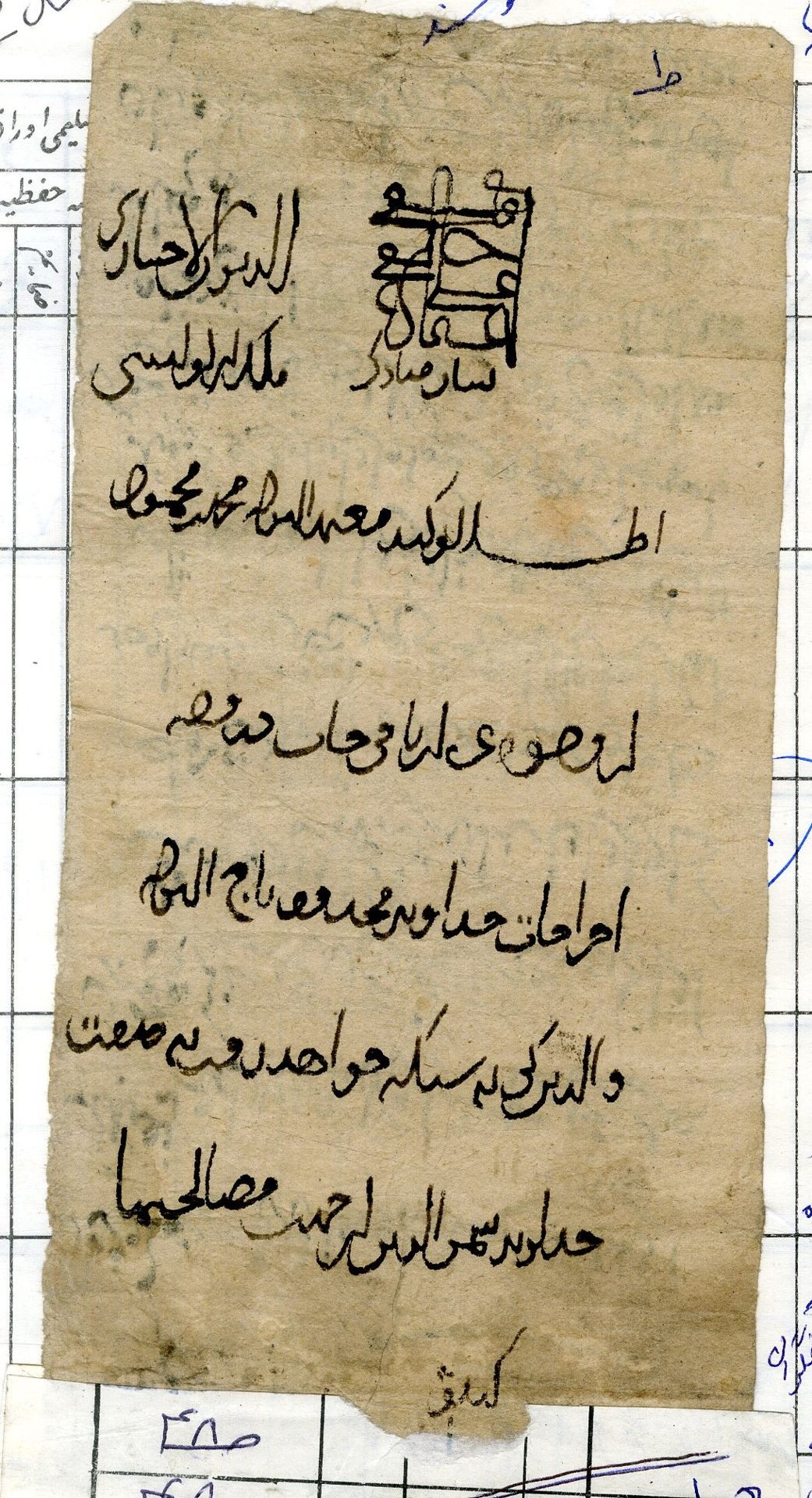
An order for payment sent from al-Dīwān al-Ikhtiyārī to Muʿtamid al-Dawla Muḥammad b. Maḥmūd to pay for the expenses of Tāj al-Dawla wal-Dīn for his travel to Sanga, where he will meet Shams al-Dīn to sort out all aspects of their reconciliation (muṣālaḥathā). The payment will be taken from the balance of the tithe budget (wujūh-i ʿushr).
The nature and quantity of the payment are unknown as they should be provided in the missing part of the document. The reference to the tithe budget suggests that this is a proportion of the tithe collected by the muʿtamid.
 

تاریخ

(Dates unknown)

جزئیات

Firuzkuh 28
Silver (given following internal peer review)
New Persian (Arabic script)
Sanga

توصیفات فیزیکی

paper
8 fold lines, black ink, bottom part missing, widely-spaced writing can be seen on the back side of the paper.
8

نشریات مرتبط

  • Khwaja Muhammad and Nabi Saqee, Barg-hāy az yak faṣl, yā asnād-i tārīkhī-yi Ghur (Kabul: Saʿīd 1388/2009) (Pages: 66-67)
    The IEDC transcription has been revised from this publication.
  • https://invisibleeast.web.ox.ac.uk/article/document-of-the-month-1/25-nishan-alama-or-ughra-a-case-study-from-the-0

شماره قفسههای مرتبط

داده‌های پایگاه دیجیتال شرق مکنون

114
01/04/2024
24/05/2026

ارجاعات

Ofir Haim
Arezou Azad, Boris Liebrenz, Nabi Saqee, Pejman Firoozbakhsh, Shamim Homayun
The transcription has been revised from a previous publication (see Publications), the translation is the original work of the IEDC Team (as yet unpublished in peer-review print)
See 'How to Cite'
Images of this Text displayed on this web page are provided by Nabi Saqee.
© Nabi Saqee, All rights reserved.
If you wish to reproduce these images please contact Nabi Saqee.

تماس

invisible_east@conted.ox.ac.uk (Please include the above permalink when contacting the editorial team about this Text)
برگ‌ها
1. recto
برچسبها
Folio:
نسخه‌برداری
Folio:
اعتمادی علی خالقی و کفی      الدیوان الاختیاری 1
نشان مبارک                              ملک [+/- 2] 2
اطلاق کند معتمد الدوله محمد بن محمود 3
از وجوه عشر از باقی حساب در وجه 4
اخراجات خداوند مخدوم تاج الدولة 5
والدین کی به سنگه خواهد رفت به خدمت 6
خداوند شمس الدین از جهت مصالحتها 7
گندم (؟) 8
ترجمه
Folio:
1 My reliance is upon my creator and this suffices               al-Dīwān al-Ikhtiyārī
2 The Blessed Signet                                            Malik [+/- 2]
3 Muʿtamid al-Dawla Muḥammad b. Maḥmūd shall release [the following amount]
4 from the tithe funds left from the account, for
5 the expenses of the lord and master Tāj al-Dawla
6 wal-Dīn for travelling to Sanga to [meet with]
7 the lord Shams al-Dīn for the purpose of reconciliation.
8 Wheat (?)
پالئوگرافی

This document features a chancery script written in rotulus format. The script is curvilinear and proportioned. Bowls are rounded and letter shapes are consistent. Madd (horizontal stroke extension) is frequent. Abusive ligatures are present throughout. Baselines are gently bowed. Interlinear spacing is generous. A large space at the head of the document (ṭurra) carries the name of the office, the name of an official (illegible), and an ʿalāma. The calligraphy of the ʿalāma is made up of a series of interwoven letters which unite to give the impression of a square-shaped seal.

These features — curvilinear and proportioned script, rounded bowls, consistent letter shapes, frequent madd, abusive ligatures, curved baselines, generous interlinear spacing, and large rotulus format with ṭurra — conform to the graphic conventions of the Abbasid/Buyid chancery of Baghdad. The style of the ʿalāma, in contrast, recalls the Seljuk-derived convention of the ṭughrā.


Further Reading


  • Shawe-Taylor, Edward. 2026. “Abbasid Continuities and Seljuk Innovations: Persian State Documents in the Bamiyan and Firuzkuh Papers.” In State Documents from the Medieval Islamicate World, edited by Nadia Vidro, Arezou Azad, and Marina Rustow. Edinburgh University Press, forthcoming.


Glossary


Abusive ligature — the joining of canonically non-connecting letters (e.g. alif) to a succeeding letter; a feature of both cursive and chancery scripts

ʿAlāma — a pious motto used as a signature by officials to authenticate state documents; usually placed at the head of a document

Baseline — the line on which letters sit

Bowl — the rounded closed or semi-closed curve of a letter which descends below the baseline, as in wāw, qāf, nūn, and sīn

Curvilinear — a script characterised by long, rounded, flowing strokes, most evident in the loops of letters such as or ʿayn, and in the bowls of letters such as yāʾ or nūn; distinct from cursive

Interlinear spacing — the space between lines of text

Madd — horizontal extension of letter strokes, used to fill space or as a decorative and calligraphic feature; also referred to as mashq in some traditions

Proportioned script — a script in which letterforms are executed according to consistent geometric ratios, typically based on the height of the alif and the diameter of a circle; associated with formal calligraphic training

Rotulus — a document in the form of a long vertical scroll

Ṭughrā — an elaborate calligraphic royal monogram used as a signature on state documents, developed by the Seljuks and continued by later dynasties including the Ottomans

Ṭurra — the large blank space left at the head of a document, below the title of the issuing office; a deliberate layout convention of the chancery style

Afghanistan National Archives: Firuzkuh 28: Folio (recto)
نمایش عکس به لطف Nabi Saqee