با انتخاب یکی از گزینههای زیر، ذخیرهسازی متن تمامی نتایج جستجویتان در پایگاه دادههای شرق مکنون شروع میشود.
برای شروع ذخیرهسازی، یکی را از گزینههای زیر را انتخاب کنید.
توجه: ممکن است فرایند ذخیرهسازی دقایقی طول بکشد. لطفاً صبر کنید.
Microsoft Word (.docx)
JSON
XML
Download started
محتوا
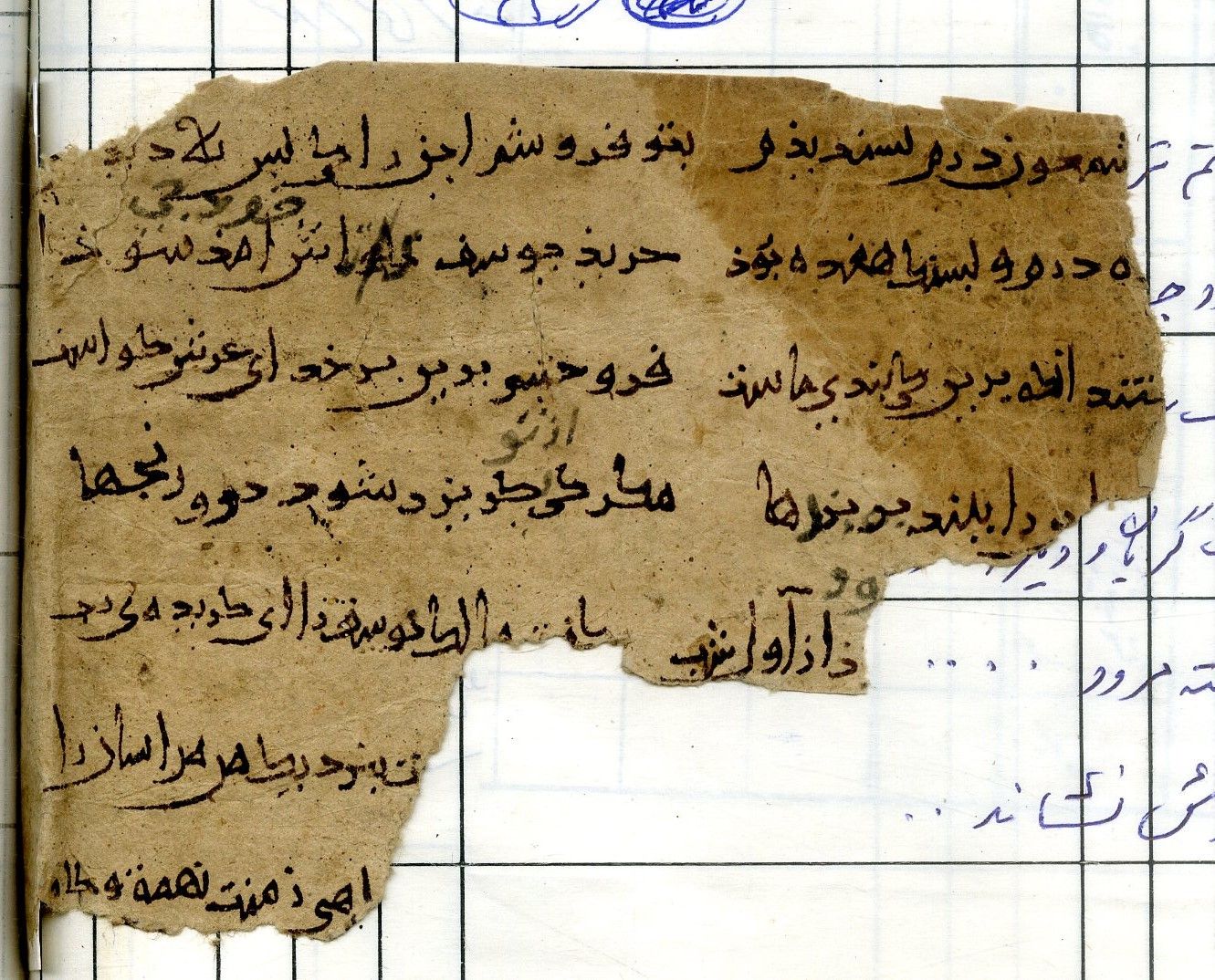
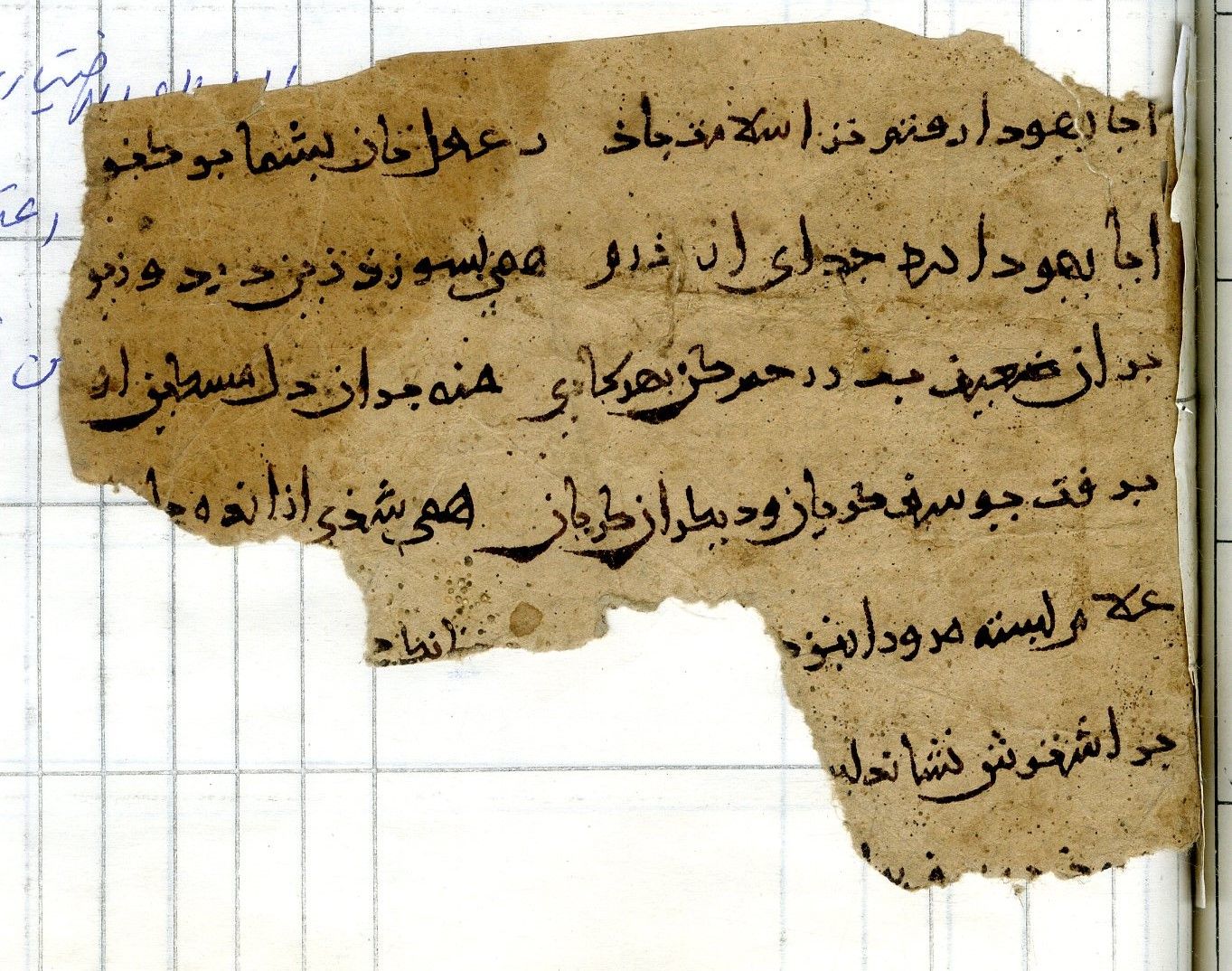
This is a rhyming poem about the story of Joseph (Yūsuf) known from the Qurʾān (sūra XII) when he was sold into slavery as a boy by his brothers. The poem includes direct speech in Yūsuf’s voice. The handwriting is stylised as in 11th-century documents ( e.g. with dotting on the dāl and lettering). A second hand has made annotations.
1[+/-3] Simon, I accepted the dirhams I sell him to you, for I have only had trouble with him
2[+/-3] dirhams which weighed 17 stones bought Joseph so that he may make a profit
3[+/-3 sold him?] then, “because he is our prisoner. We sold him thus, God of the throne is our witness
4[+/-3] tie him up in bonds lest he escapes, and causes distress”
5[+/-5] gave him (?) in the early night Mālik encountered Joseph, “O Lord’s chosen one,
6[+/-7] [+/-2 bring?] him close to me,
7[+/-7] [+/-4] hidden from me at times (?)
1“O Judas, I am gone, farewell! Your conscience [shall reprimand?] you [+/-2]
2O Judas, I suffered the pain of separation [my body?] is burning from this pain [+/-4]
3Upon [my] weak father, always have mercy Do not lodge [+1] [grief] in his wretched heart”
4Joseph left in tears and the others cried He walked away, in despair [+/-4]
5The guard bound him, and [took] him to [+/-2] Such that [+/-5]
6He seated him on a camel [+/-3] [+/-6]
7[+/-6] [+/-6]
پالئوگرافی
This fragment is written in the angular script of a bookhand typical of the tenth century. The baseline is straight. The heads of looped letters such as fāʾ, mīm, and wāw are pointed, while the bowls of descending letters such as yāʾ and nūn are flattened and open. The letter kāf is written in its archaic form with distinct orthogonality, formed of a vertical stroke which transitions into the baseline through a series of three perfect right angles. On the verso, the tails of nūn have been accentuated with a thicker qalam, giving them a distinctive triangular form.
Angular — a script style in which letterforms are constructed using straight strokes meeting at sharp angles, without curves; characteristic of early Arabic bookhands and ‘New Style’ Qur’anic scripts
Baseline — the line on which letters sit
Bookhand — a script style associated with the copying of manuscripts, typically more formal and regular than documentary hands
Bowl — the rounded closed or semi-closed curve of a letter which descends below the baseline, as in wāw, qāf, nūn, and sīn
Descender — the portion of a letter that extends below the baseline, as in rāʾ, zāyy, and lām
Orthogonal — composed of right angles; used to describe scripts in which strokes meet at ninety degrees, producing a rigid, angular aspect
Qalam — Arabic term derived from the Greek kalamos; the reed pen used for writing
This fragment is written in the angular script of a bookhand typical of the tenth century. The baseline is straight. The heads of looped letters such as fāʾ, mīm, and wāw are pointed, while the bowls of descending letters such as yāʾ and nūn are flattened and open. The letter kāf is written in its archaic form with distinct orthogonality, formed of a vertical stroke which transitions into the baseline through a series of three perfect right angles. On the verso, the tails of nūn have been accentuated with a thicker qalam, giving them a distinctive triangular form.
Angular — a script style in which letterforms are constructed using straight strokes meeting at sharp angles, without curves; characteristic of early Arabic bookhands and ‘New Style’ Qur’anic scripts
Baseline — the line on which letters sit
Bookhand — a script style associated with the copying of manuscripts, typically more formal and regular than documentary hands
Bowl — the rounded closed or semi-closed curve of a letter which descends below the baseline, as in wāw, qāf, nūn, and sīn
Descender — the portion of a letter that extends below the baseline, as in rāʾ, zāyy, and lām
Orthogonal — composed of right angles; used to describe scripts in which strokes meet at ninety degrees, producing a rigid, angular aspect
Qalam — Arabic term derived from the Greek kalamos; the reed pen used for writing