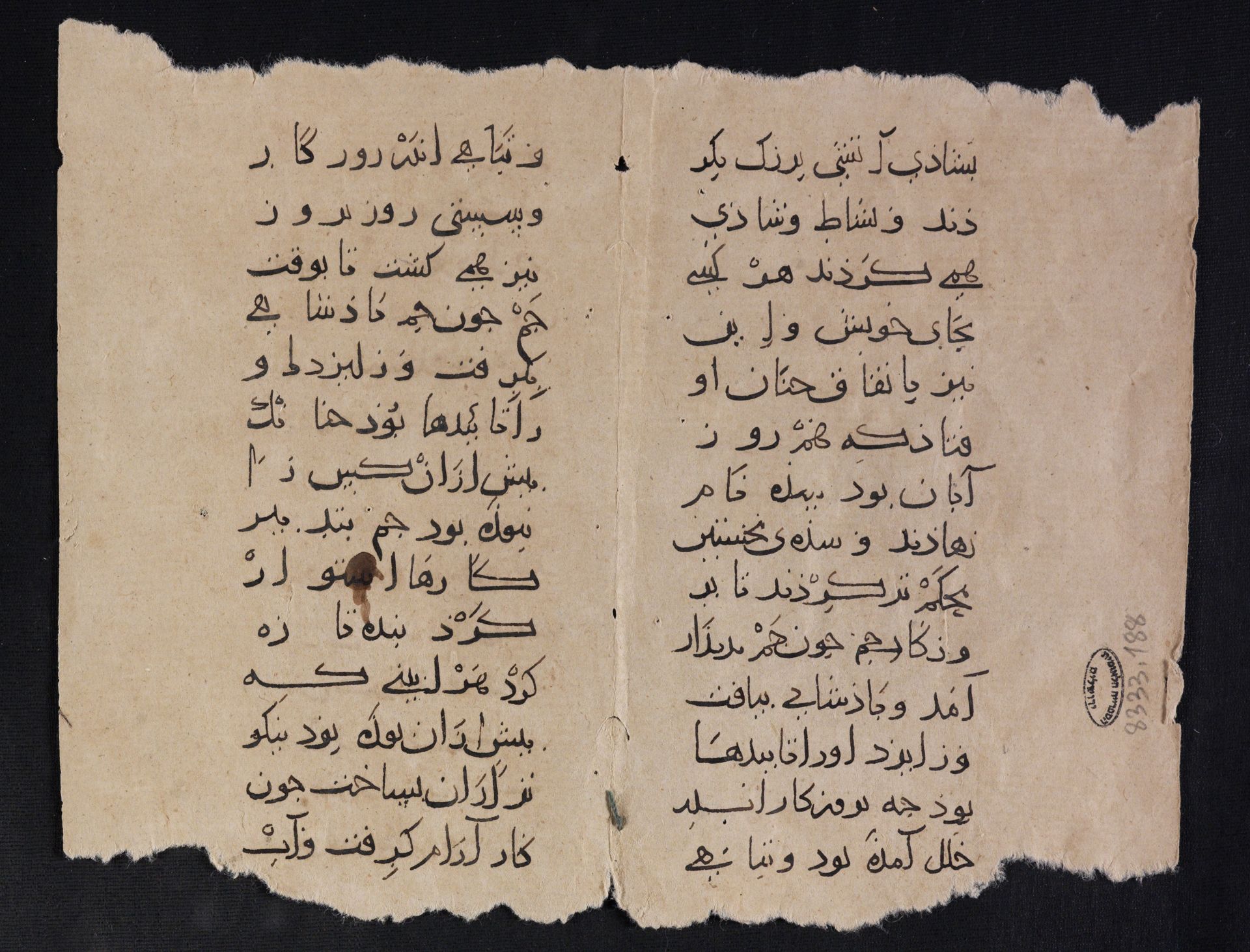
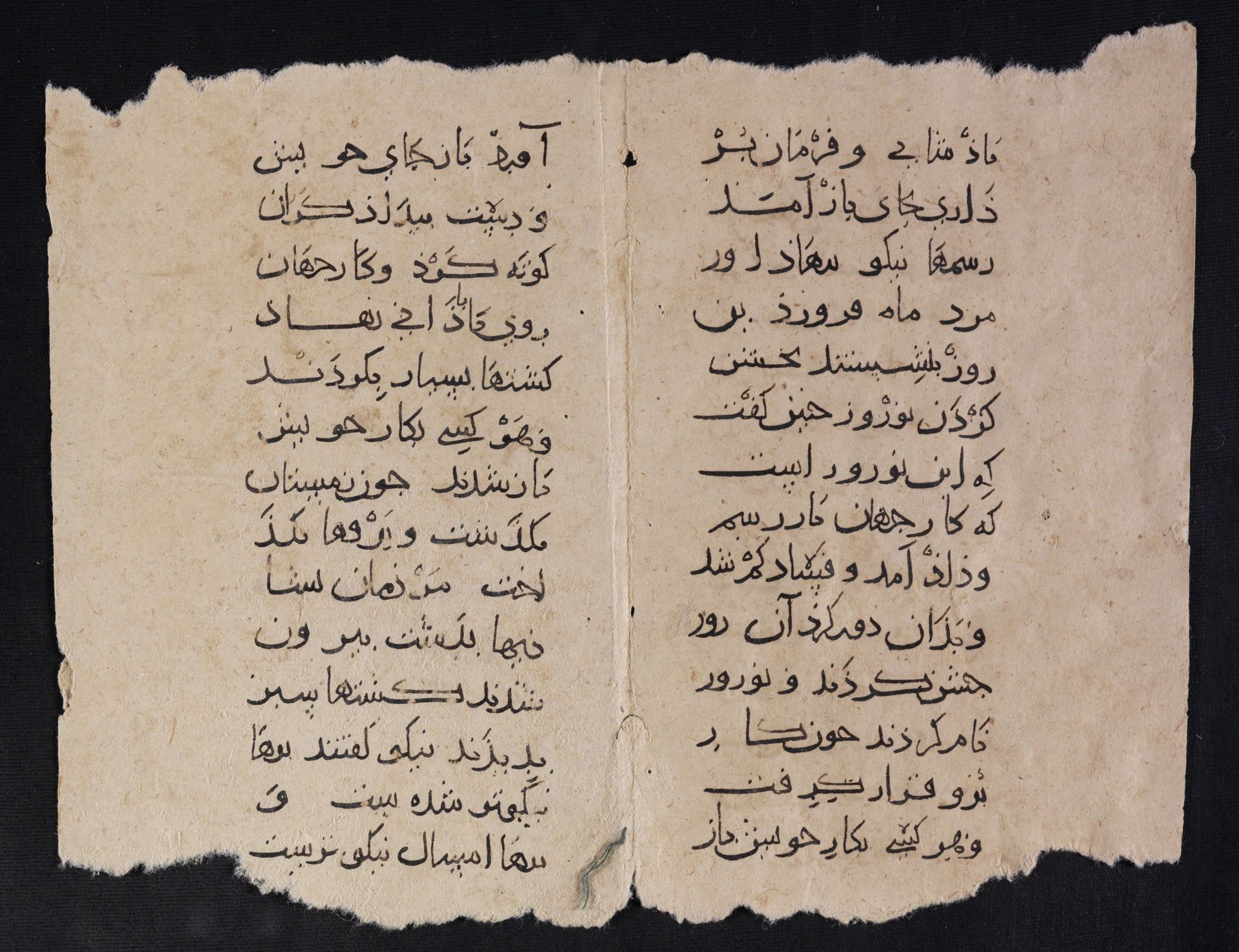
Good condition bifolio, holes where thread bound the quire, 14 lines on each of the four sides, black ink fragmentary text
17.8
18.0
اشخاص
نشریات مرتبط
Shaked, Shaul. 2018. ‘Yima in a Newly Discovered Manuscript’. In Arj-i Khirad: Jashnnama-yi Ustad Jalal Khalighi Mutlagh [The Value of Wisdom: Festschrift for professor Jalal Khalighi Mutlagh], edited by Farhad Aslani and Masoume Pourtaghi. Morvarid Publishing. Pp. 21-28
6on the tenth day of the month (of bahman?), and it was named sada.
8The fostered the original sada
9until
10Jam’s time. When Jam appeared [on the scene]
11and assumed the kingship --
12with much support from god [and]
13because of the chaos and corruption that abounded
Left side (page 1)
14The corruption of the time and
15impotence that abounded
16continued until the era of
17Jam. After Jam assumed the kingship,
18with the support of god at
7hitherto unseen levels,
8he took care of
9all matters with wisdom.
10He revived the sada (?)
11[festival], He improved all customs
12that had pre-existed.
13When
14the situation became stable and the [good] reputation of
Right side (page 2)
1the monarchy and rule
2had been restored,
3he put in place sound customs.
4On the day of Ūrmazd (i.e. the 1st day) of month of farvardīn,
5they would gather to celebrate
6the new year (nawrūz). He spoke thus,
7“Today is the new day
8because order to the world
9and justice have come, and depravity has vanished
10and the villains have been kept at bay!” That day
11they held a celebration and called it
12nawrūz (“new day”). After assuming power,
14he reinstated everyone in their
Left side (page 3)
15original posts,
16and disempowered the oppressors.
17The affairs of the world
18began to flourish.
19They farmed a lot,
20and everyone returned to
21work. After the winters
22when the snows melted,
23the people would
24go out into the meadows filled with joy.
25They would see the green,
26beautiful farms, and exclaim,
27“How the quality of the produce has improved,
28and this year’s harvest is even better!”
پالئوگرافی
This fragment is written in the angular script of a bookhand typical of the tenth century. The script is transitional between the angular scripts that characterised ninth- and tenth-century bookhands and the curvilinear scripts which began to appear in the tenth century. The baseline is very straight. Spaces are often left between letters — including those within the same word — in order to justify the page, a practice ultimately deriving from Kufic calligraphy. The letter kāf is mostly executed in its more archaic form, made up of a single stroke and featuring a long horizontal extension of two parallel lines. On line 11 of the left-hand side of the recto, however, a kāf more typical of curvilinear scripts also appears, made up of an inward-curving ligature with a separate stroke attached at the head. The bowls of letters such as nūn and sīn are perfectly rounded to form a semicircle, recalling the newly emerging curvilinear style.
Angular — a script style in which letterforms are constructed using straight strokes meeting at sharp angles, without curves; characteristic of early Arabic bookhands and ‘New Style’ Qur’anic scripts
Baseline — the line on which letters sit
Bookhand — a script style associated with the copying of manuscripts, typically more formal and regular than documentary hands
Bowl — the rounded closed or semi-closed curve of a letter which descends below the baseline, as in wāw, qāf, nūn, and sīn
Curvilinear — a script characterised by long, rounded, flowing strokes, most evident in the loops of letters such as fā or ʿayn, and in the bowls of letters such as yāʾ or nūn; distinct from cursive
Justification — the process of aligning text so that both the left and right edges are flush with the margins, creating a clean, rectangular block of text
Kufic — an early angular Arabic script used in Qur’anic manuscripts from the eighth to tenth centuries, characterised by angular letterforms and horizontal page orientation
Ligature — the joining of two or more letters into a single connected stroke
Transitional script — a script which exhibits features of two distinct scribal traditions, reflecting a period of change between one dominant style and another
This fragment is written in the angular script of a bookhand typical of the tenth century. The script is transitional between the angular scripts that characterised ninth- and tenth-century bookhands and the curvilinear scripts which began to appear in the tenth century. The baseline is very straight. Spaces are often left between letters — including those within the same word — in order to justify the page, a practice ultimately deriving from Kufic calligraphy. The letter kāf is mostly executed in its more archaic form, made up of a single stroke and featuring a long horizontal extension of two parallel lines. On line 11 of the left-hand side of the recto, however, a kāf more typical of curvilinear scripts also appears, made up of an inward-curving ligature with a separate stroke attached at the head. The bowls of letters such as nūn and sīn are perfectly rounded to form a semicircle, recalling the newly emerging curvilinear style.
Angular — a script style in which letterforms are constructed using straight strokes meeting at sharp angles, without curves; characteristic of early Arabic bookhands and ‘New Style’ Qur’anic scripts
Baseline — the line on which letters sit
Bookhand — a script style associated with the copying of manuscripts, typically more formal and regular than documentary hands
Bowl — the rounded closed or semi-closed curve of a letter which descends below the baseline, as in wāw, qāf, nūn, and sīn
Curvilinear — a script characterised by long, rounded, flowing strokes, most evident in the loops of letters such as fā or ʿayn, and in the bowls of letters such as yāʾ or nūn; distinct from cursive
Justification — the process of aligning text so that both the left and right edges are flush with the margins, creating a clean, rectangular block of text
Kufic — an early angular Arabic script used in Qur’anic manuscripts from the eighth to tenth centuries, characterised by angular letterforms and horizontal page orientation
Ligature — the joining of two or more letters into a single connected stroke
Transitional script — a script which exhibits features of two distinct scribal traditions, reflecting a period of change between one dominant style and another