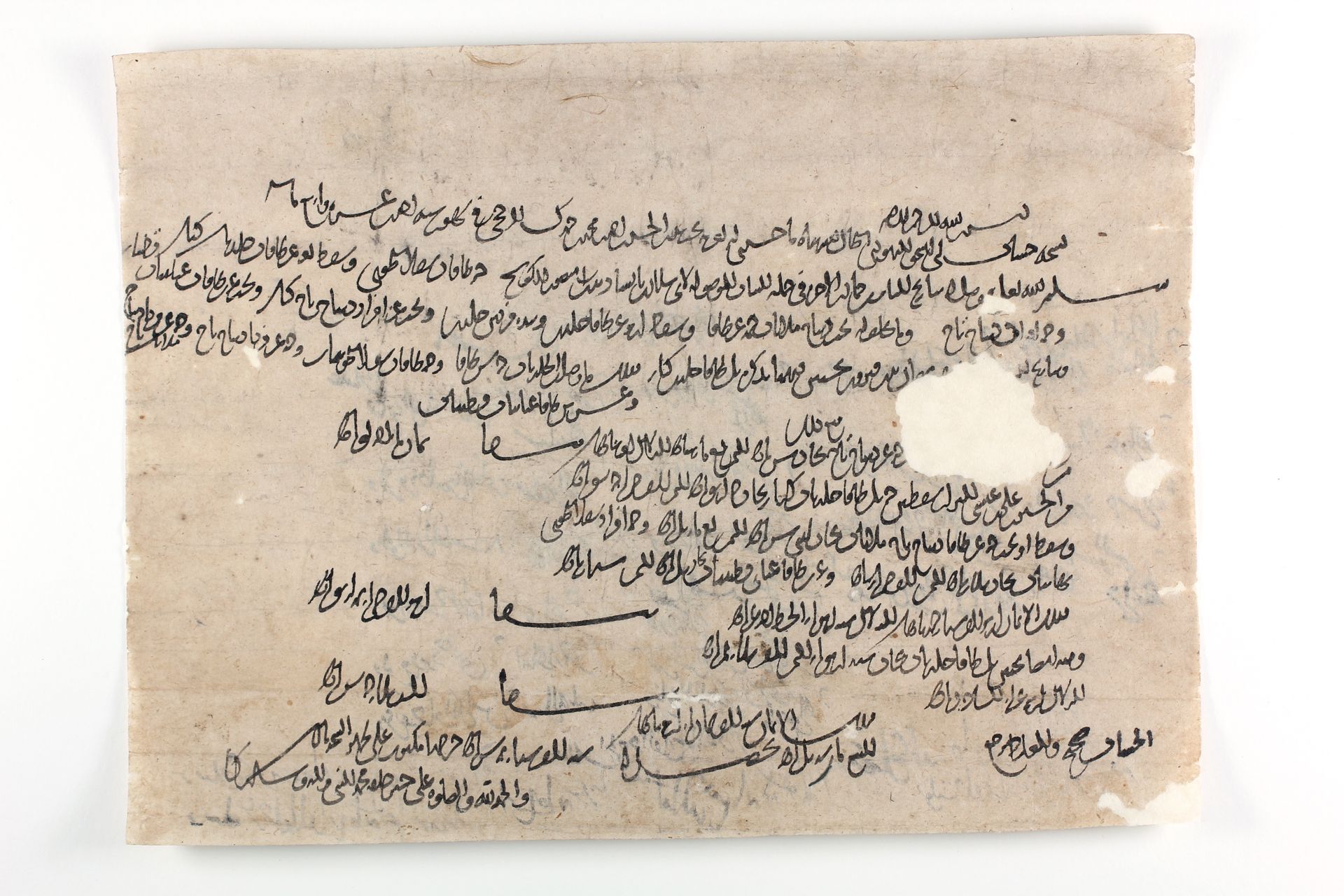
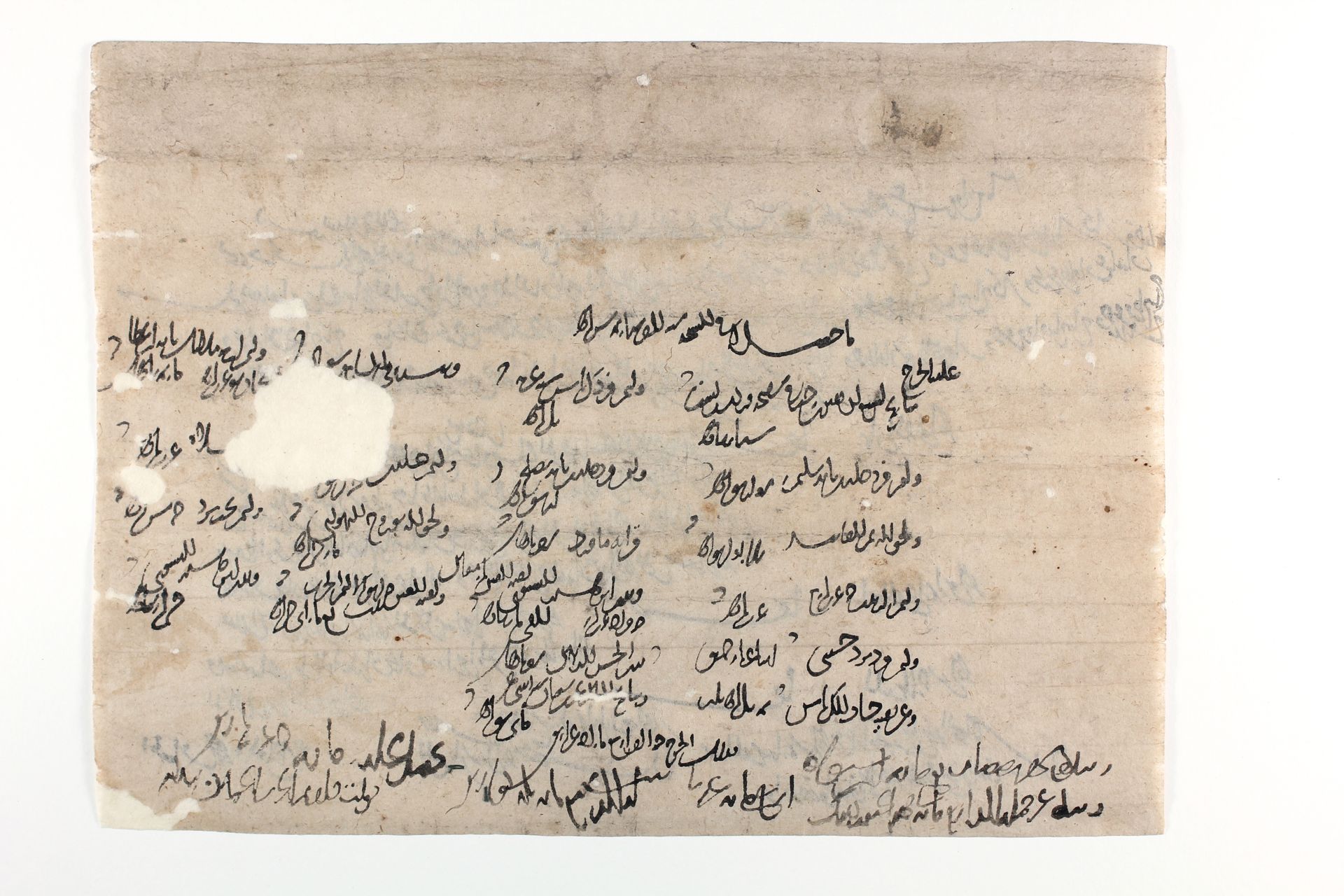
The script of this document combines conventions of the Abbasid chancery with features from Pahlavi documentary culture. The script is curvilinear and proportioned with a pronounced downward diagonal slant. Letterforms combine the rounded, regularised forms associated with the alif-circle reforms of the Abbasid chancery with the more angular, diagonal ductus of Pahlavi-influenced Arabic documentary hands from Khurāsān. Final letters retain open, flattened curves consistent with the latter tradition. Baselines are nested and stacked, resulting in a boat-like curvature across the page. The ductus is of variable width with pervasive hairlines. Ascenders are vertical or rotated slightly counterclockwise. Interlinear spacing is generous. The scribe employs marked horizontal stroke extension (madd), most conspicuously in numerals and units of currency. The document closes with the ḥamdala in the hand of the main scribe.
These features — nested and fragmenting baselines, boat-shaped line curvature, variable ductus, pervasive hairlines, curvilinear and proportioned letterforms, and generous interlinear spacing — conform to the graphic conventions of the Abbasid/Buyid chancery of Baghdad.
Glossary
Alif-circle — the geometric basis for proportioned scripts, in which the height of the alif and the diameter of a circle set the proportional ratios for all other letterforms
Angular — a script style in which letterforms are constructed using straight strokes meeting at sharp angles, without curves; characteristic of early Arabic bookhands and ‘New Style’ Qur’anic scripts
Ascender — the part of a letter that extends above the main body of the script, as in alif or lām
Boat-shaped — a line curvature that bows gently at the centre of the line before rising steeply at the left end of the page; characteristic of Abbasid-derived chancery scripts
Curvilinear — a script characterised by long, rounded, flowing strokes, most evident in the loops of letters such as fā or ʿayn, and in the bowls of letters such as yāʾ or nūn; distinct from cursive
Documentary hand — a script style associated with the production of administrative, legal, or commercial documents, typically less formal than a bookhand
Ductus — the movement of the pen caused by the gestures of the scribe when writing; particularly relevant when describing variation in stroke width between thick and thin strokes
Hairline — a very fine, thin stroke, typically connecting letters
Ḥamdala — the closing formula al-ḥamdu li-llāh (“praise be to God”); standard at the close of Islamic documents
Interlinear spacing — the space between lines of text
Madd — horizontal extension of letter strokes, used to fill space or as a decorative and calligraphic feature; also referred to as mashq in some traditions
Nested baselines — baselines of individual words which are slanted, with succeeding words beginning above the end of the preceding word
Proportioned script — a script in which letterforms are executed according to consistent geometric ratios, typically based on the height of the alif and the diameter of a circle; associated with formal calligraphic training
Further Reading
- Rustow, Marina. 2020. The Lost Archive: Traces of a Caliphate in a Cairo Synagogue. Princeton: Princeton University Press.