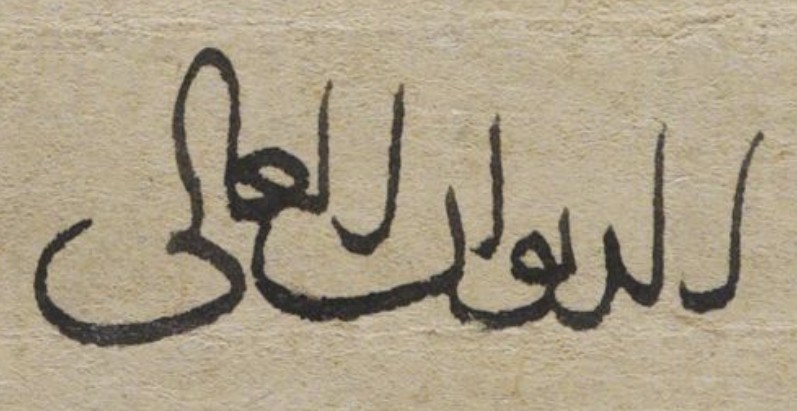
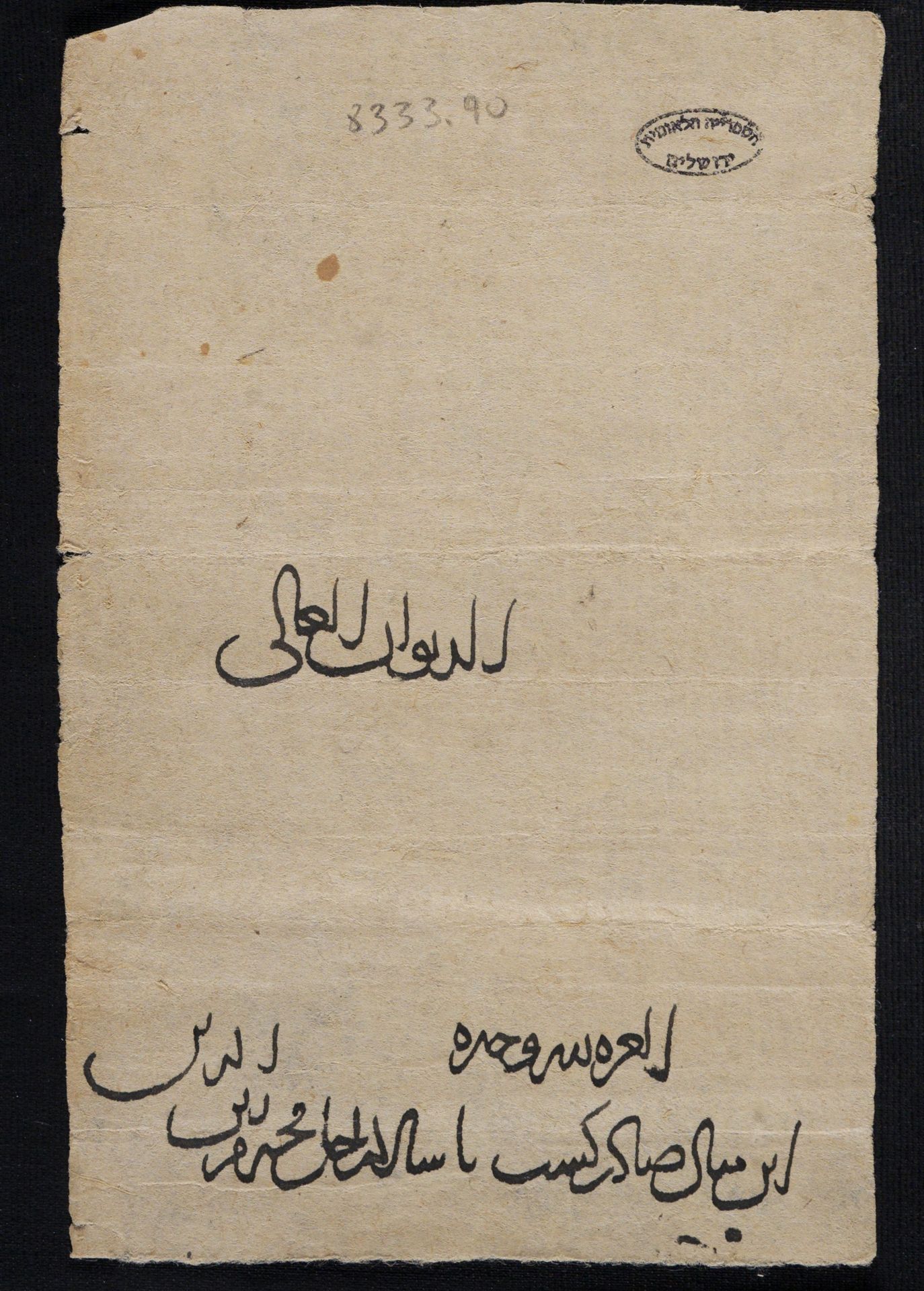
This document features a chancery script written in rotulus format. The script is curvilinear and proportioned with a variable ductus. Letter shapes are regular and consistent: the open spaces in the heads of letters such as wāw and ʿayn are clear and pronounced.
e.g. al-dīwān al-ʿālī line 3:

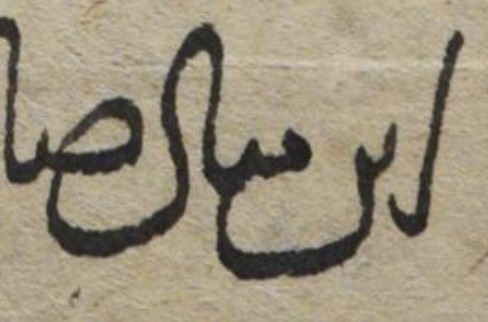
The bowls of letters such as wāw, nūn and lām are rounded. and abusive ligatures are frequent.
e.g. ʾīn mithāl line 3:

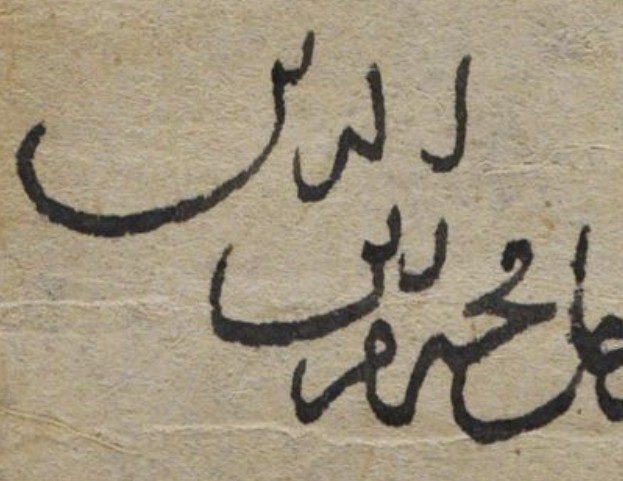
Baselines are nested and stacked, with each succeeding word beginning above the previous. Words are stacked toward the ends of lines.
e.g. muḥtaram Zayn al-Dīn line 3:

Interlinear spacing is wide. Lines slope upward. The heading carries the title al-Dīwān al-ʿĀlī, followed by an ʿalāma (al-ʿizza li-llāh waḥdahu) set at a conspicuous distance from the preceding text, consistent with standard chancery layout convention. The document is approximately 10 cm wide and written on a distinct paper stock.
These features — curvilinear and proportioned script, variable ductus, pervasive hairlines, abusive ligatures, nested and stacked baselines, stacked words at line-ends, wide interlinear spacing, and upward-sloping lines — conform to the graphic conventions of the Abbasid/Buyid chancery of Baghdad.
Glossary
Abusive ligature — the joining of canonically non-connecting letters (e.g. alif) to a succeeding letter; a feature of both cursive and chancery scripts
ʿAlāma — a pious motto used as a signature by officials to authenticate state documents; usually placed at the head of a document
Curvilinear — a script characterised by long, rounded, flowing strokes, most evident in the loops of letters such as fā or ʿayn, and in the bowls of letters such as yāʾ or nūn; distinct from cursive
Ductus — the movement of the pen caused by the gestures of the scribe when writing; particularly relevant when describing variation in stroke width between thick and thin strokes
Hairline — a very fine, thin stroke, typically connecting letters
Interlinear spacing — the space between lines of text
Nested baselines — baselines of individual words which are slanted, with succeeding words beginning above the end of the preceding word
Proportioned script — a script in which letterforms are executed according to consistent geometric ratios, typically based on the height of the alif and the diameter of a circle; associated with formal calligraphic training
Rotulus — a document in the form of a long vertical scroll
Stacked words — words written above one another toward the end of a line, a deliberate layout convention of the chancery style
Further Reading
- Rustow, Marina. 2020. The Lost Archive: Traces of a Caliphate in a Cairo Synagogue. Princeton: Princeton University Press.
- Shawe-Taylor, Edward. 2026. “Abbasid Continuities and Seljuk Innovations: Persian State Documents in the Bamiyan and Firuzkuh Papers.” In State Documents from the Medieval Islamicate World, edited by Nadia Vidro, Arezou Azad, and Marina Rustow. Edinburgh University Press, forthcoming.