Khalili Collection: DOC 25 [AR 16]
  • Details
  • Tags
  • Transcriptions
  • Translations
  • Palaeography
  • Seals
Details
Download

Download IEDC Data

You are about to download data for the current text from the IEDC database.

To start the download, please click on your desired format below.

Note: it can take up to several minutes to download your data, so please wait whilst it processes

Download started

Content

Tax quittance for Mīr b. Bēk. Although a location is not mentioned in the text, the persons named suggest Madr and Rizm as the jurisdictional district.

Dates

  • The Gregorian calendar: June-July 767 (0767-08-06 - 0767-07-07)
  • The Hijri calendar: Jumādā I 150 (0150-05)

Details

DOC 25 [AR 16]
Khalili Collection
Gold (given following external peer review through journal/book publication)
Arabic (Arabic script)
Administrative: Receipt

Physical Description

parchment
fold lines
Written on light brown-colored parchment, the writing surface shows fold lines.
8.5
7.0

Publications

  • Khan, Geoffrey. 2007. Arabic documents from early Islamic Khurasan (Studies in the Khalili Collection Volume V). London: The Nour Foundation in association with Azimuth Editions. (Pages: 106-107)
    Catalogue Number: 8
    The IEDC translation and transcription have been taken from this publication

Related Shelfmarks

IEDC Data

47
02/12/2023
24/05/2026

Citations

Geoffrey Khan
Thomas Benfey
The transcription and translation have been taken from a previous publication (see Publications)
See 'How to Cite'
Images of this Text displayed on this web page are provided by Khalili Collection.
© Khalili Collection, All rights reserved.
If you wish to reproduce these images please contact Khalili Collection.

Contact

invisible_east@conted.ox.ac.uk (Please include the above permalink when contacting the editorial team about this Text)
Folios
1. recto
Tags
Folio:
Transcription
Folio:
بسم الله الرحمن الرحيم 1
هذا كتاب من شهاب بن عمرو 2
عامل الامير ابى غالب بن الاصبهبذ اعز الله 3
نصره براة لمير بن بك انك اديت الى 4
مما صار عليك من قسمة الثلث 5
والقسمتين خمسة دراهم وقبضت 6
ذلك منك وبرئت الى منها 7
وكتب فى جمادى الاولى سنة 8
خمسين ومية 9
Translation
Folio:
1 In the name of God, the Merciful and Compassionate.
2 This is a document from Shihāb b. ʿAmr,
3 the financial administrator of the governor Abū Ghālib b. al-Iṣbahbadh, may God strengthen
4 his victory, a quittance for Mīr b. Bēk. You have delivered to me
5 what you owe with regard to the portion of the third
6 and the two portions, five dirhams. I have received
7 that from you and you have been released from (the obligation to pay) them to me.
8 It has been written in Jumādā I of the year
9 one hundred and fifty.
Palaeography

This document features a chancery script. The script is highly cursive. There is little to no lifting of the pen between strokes, resulting in frequent abusive ligatures. Letters are highly compressed and often written with a notable diagonal slant which contradicts the baseline, which is perfectly flat and straight. Words are crowded across the line, occasionally alleviated using madd (letter lengthening). The curves of letters such as rāʾ, zāyy, and lām have been flattened.

These features — flattened letter shapes, obtuse angles, open curves, diagonal descenders, frequent abusive ligatures, and compressed letterforms — are also found in contemporary Pahlavi documents. It is possible that bilingual Arabic-Pahlavi administrators imported the ductus of Pahlavi script into their Arabic writing.


Further Reading


  • Rustow, Marina. 2020. The Lost Archive: Traces of a Caliphate in a Cairo Synagogue. Princeton: Princeton University Press.


Glossary


Abusive ligature — the joining of canonically non-connecting letters (e.g. alif) to a succeeding letter; a feature of both cursive and chancery scripts

Baseline — the line on which letters sit

Cursive — in Arabic palaeography, a technical term describing scripts characterized by obtuse angles, open curves, and diagonal strokes

Descender — the portion of a letter that extends below the baseline, as in rāʾ, zāyy, and lām

Ductus — the movement of the pen caused by the gestures of the scribe when writing; particularly relevant when describing variation in stroke width between thick and thin strokes

Madd — horizontal extension of letter strokes, used to fill space or as a decorative and calligraphic feature; also referred to as mashq in some traditions

Seals
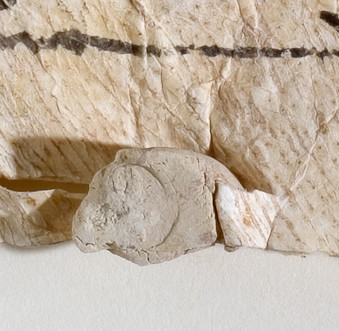
Seal 1
Photograph of this seal
ِAnimal (?)

The seal impression is damaged but appears to be the image of an animal.

  • brown
  • animals
Khalili Collection: DOC 25 [AR 16]: Folio (recto)
Images courtesy of Khalili Collection