Khalili Collection: DOC 34 [AR 22]
  • Details
  • Tags
  • Transcriptions
  • Translations
  • Palaeography
  • Map
  • Seals
Details
Download

Download IEDC Data

You are about to download data for the current text from the IEDC database.

To start the download, please click on your desired format below.

Note: it can take up to several minutes to download your data, so please wait whilst it processes

Download started

Content

Tax quittance for Qārwāl b. Mīr.

Dates

  • The Gregorian calendar: March-April 775 (0775-03-13 - 0775-04-11)
  • The Hijri calendar: Jumādā I 158 (0158-05)

Details

DOC 34 [AR 22]
Khalili Collection
Gold (given following external peer review through journal/book publication)
Arabic (Arabic script)
Administrative: Receipt

Physical Description

parchment
fold lines
Written on light coloured parchment, the writing surface shows fold lines.
5.5
5.5

Publications

  • Khan, Geoffrey. 2007. Arabic documents from early Islamic Khurasan (Studies in the Khalili Collection Volume V). London: The Nour Foundation in association with Azimuth Editions. (Pages: 132-3)
    Catalogue Number: 21
    The IEDC translation and transcription have been taken from this publication

Related Shelfmarks

IEDC Data

48
02/12/2023
09/08/2026

Citations

Geoffrey Khan
Thomas Benfey
The transcription and translation have been taken from a previous publication (see Publications)
See 'How to Cite'
Images of this Text displayed on this web page are provided by Khalili Collection.
© Khalili Collection, All rights reserved.
If you wish to reproduce these images please contact Khalili Collection.

Contact

invisible_east@conted.ox.ac.uk (Please include the above permalink when contacting the editorial team about this Text)

Folios
1. recto
Tags
Folio:
Transcription
Folio:
بسم الله الرحمن الرحيم 1
هذه براة من منصور بن 2
سليمان عامل الامير محمد بن حبيب 3
اعز الله نصره على وسبا ورزم ومدر 4
للقاروال بن مير انك اديت الى مما 5
صار عليك فى قصر يسكن وغندر من قسمة 6
نفقات الارض ونفقات المهدى ونفقا 7
ت الامير ونفقة من تجهز الى المهدى 8
امتع الله به من الرقيق والاسارى 9
وغير ذلك مع خراج سنة سبع وخمسين وماية 10
خمسة دونيق ونصف دانق قبضت 11
ذلك منك وبرئت الى منها 12
وكتب فى جمادى الاولى سنة ثمان 13
وخمسين ومــــــــــــــــــــــاية 14
Translation
Folio:
1 In the name of God, the Merciful and Compassionate.
2 This is a quittance from Manṣūr b.
3 Sulaymān, the financial administrator of the governor Muḥammad b. Ḥabīb,
4 may God strengthen his victory, (whose jurisdiction is) over Wasbā (?), Rizm and Madr,
5 to al-Qārwāl b. Mīr. You have delivered to me what
6 you owe in the citadel of Yaskin and Ghandar with regard to the portion
7 for the expenses of the land, the expenses of al-Mahdī, the expenses
8 of the governor, the expenses of captives and slaves who equipped themselves to join al-Mahdī,
9 may God grant him enjoyment (of life),
10 and other (expenses), (which are administered) with the kharāj for the year one hundred and fifty-seven,
11 five dānaqs and one half dānaq. I have received
12 that from you and you have been released from (the obligation to pay) them to me.
13 It has been written in Jumādā I of the year
14 one hundred and fifty-eight.
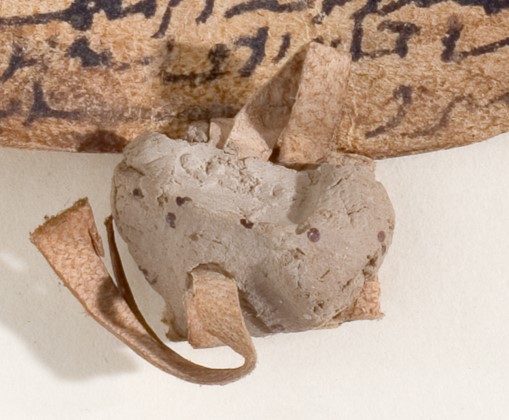
15 Bulla
16 Manṣūr
Palaeography

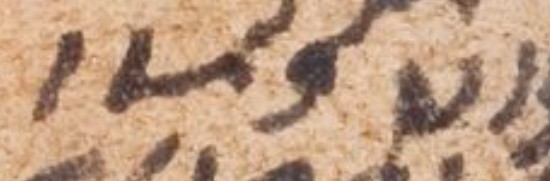
This document features a chancery script. The script is highly cursive. Letters are highly compressed and often written with a notable diagonal slant which contradicts the baseline, which is perfectly flat and straight.

Words are crowded across the line, occasionally alleviated using madd (letter lengthening).
e.g. hādhihi line 2


The curves of letters such as rāʾ, dāl, and lām have been flattened.
e.g. Rizm wa Madr line 4


Some of these features, particularly flattened curves and diagonal strokes, are also found in contemporary Pahlavi documents. It is possible that bilingual Arabic-Pahlavi administrators imported elements of the ductus of Pahlavi script into their Arabic writing.


Glossary


Baseline — the line on which letters sit

Cursive — in Arabic palaeography, a technical term describing scripts characterized by obtuse angles, open curves, and diagonal strokes

Descender — the portion of a letter that extends below the baseline, as in rāʾ, zāyy, and lām

Ductus — the movement and sequence of strokes made by the scribe in forming letters

Madd — horizontal extension of letter strokes, used to fill space or as a decorative and calligraphic feature; also referred to as mashq in some traditions


Further Reading


Rustow, Marina. 2020. The Lost Archive: Traces of a Caliphate in a Cairo Synagogue. Princeton: Princeton University Press, 161-166.


Map

This map displays the place names identified by the Invisible East Team related to this corpus text. If you click on a pin, you can see all the texts in our corpus which mention this toponym. Please bear in mind that the exact geographical location of origin is not always possible to establish. It is, therefore, only an approximation.

You can also view a full map of all toponyms within the Invisible East Digital Corpus.

Seals
Seal 1
Photograph of this seal
Inscription

Seal inscribed with the name "Manṣūr".

منصور

  • inscription
  • brown
  • inscriptions
Khalili Collection: DOC 34 [AR 22]: Folio (recto)
Images courtesy of Khalili Collection