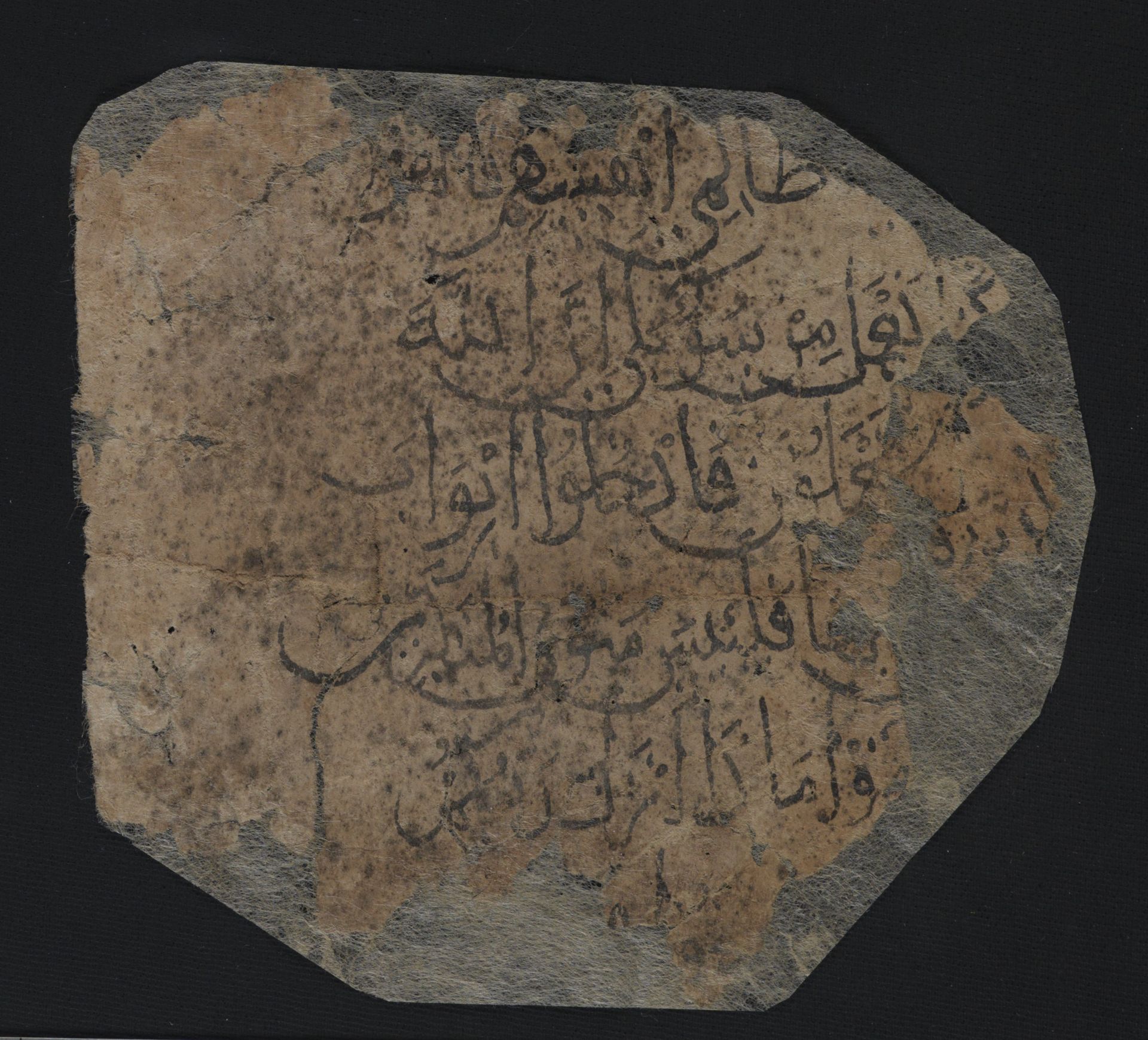
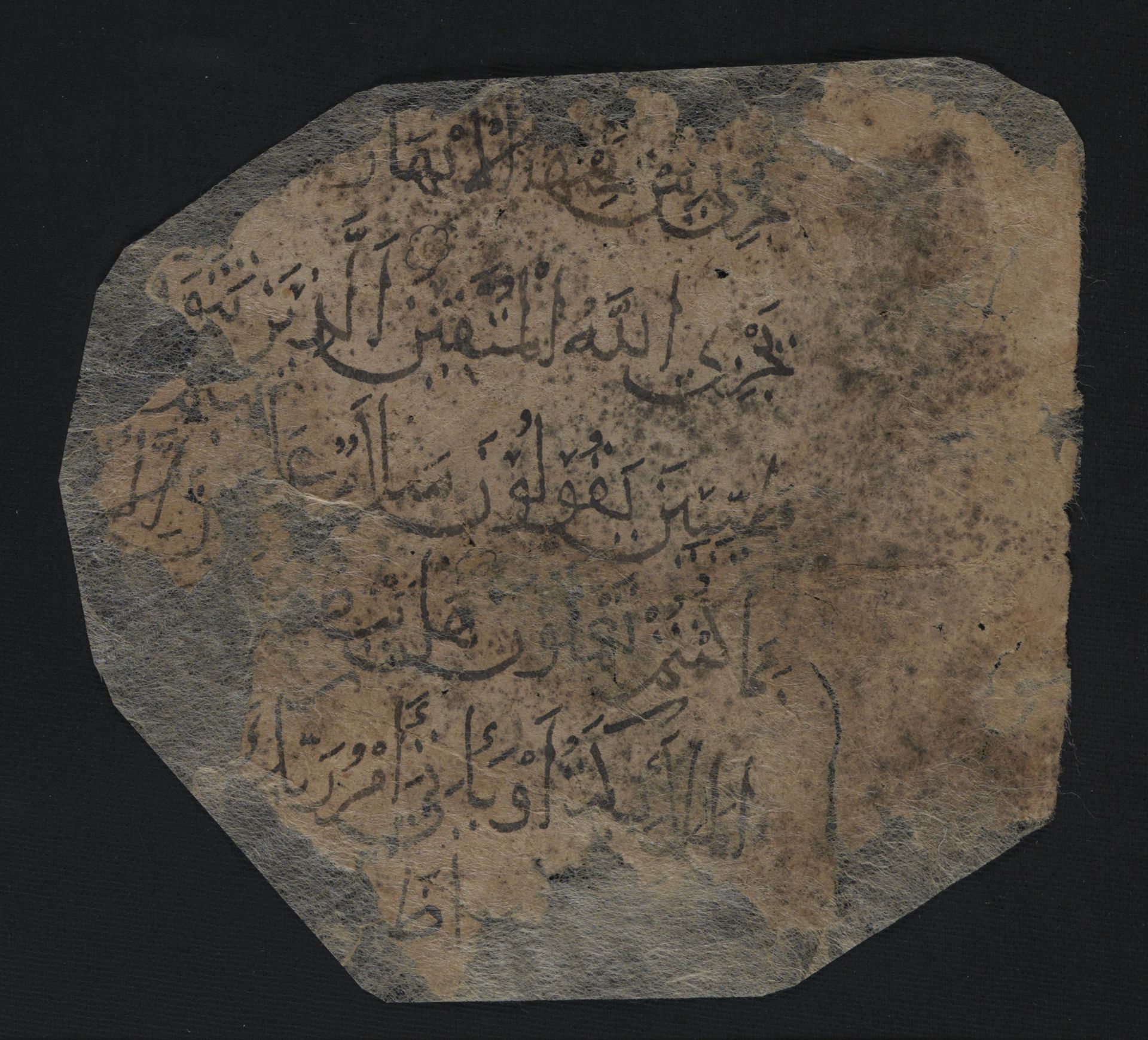
4“...there.” Surely, wretched is the abode of the arrogant
5… “What has your Lord sent down?”
1…flows under them the rivers…
2Thus shall God recompense the righteous, whom will reclaim…
3In all their virtue, saying “peace be upon…
4For what you did.” Are they waiting…
5The angels or the command of your Lord?
Palaeography
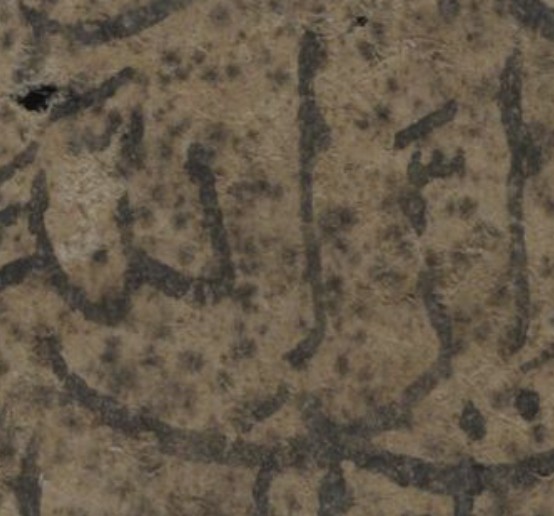
This fragment is written in a Qur’anic script known as the ‘Round Style’, a proportioned script characterised by its curvilinear features. It developed from book scripts and everyday documentary hands of the period. The script features generous and perfectly rounded bowls for letters such as nūn and lām. The script is proportioned on the basis of the alif and circle — the diameter of bowl letters such as nūn is equal to the height of the alif. Vocalisation is marked in the modern system, with vowel signs written in the same black ink as the main text. The script, ink, and vocalisation system are consistent with NLI MS.Heb.8333.182, indicating production by the same hand or workshop.
Alif-circle — the geometric basis for proportioned scripts, in which the height of the alif and the diameter of a circle set the proportional ratios for all other letterforms
Bookhand — a script style associated with the copying of manuscripts, typically more formal and regular than documentary hands
Bowl — the rounded closed or semi-closed curve of a letter which descends below the baseline, as in wāw, qāf, nūn, and sīn
Curvilinear — a script characterised by long, rounded, flowing strokes, most evident in the loops of letters such as fā or ʿayn, and in the bowls of letters such as yāʾ or nūn; distinct from cursive
Documentary hand — a script style associated with the production of administrative, legal, or commercial documents, typically less formal than a bookhand
Proportioned script — a script in which letterforms are executed according to consistent geometric ratios, typically based on the height of the alif and the diameter of a circle; associated with formal calligraphic training
Round Style — a Qur’anic script characterised by proportioned curvilinear letterforms
This fragment is written in a Qur’anic script known as the ‘Round Style’, a proportioned script characterised by its curvilinear features. It developed from book scripts and everyday documentary hands of the period. The script features generous and perfectly rounded bowls for letters such as nūn and lām. The script is proportioned on the basis of the alif and circle — the diameter of bowl letters such as nūn is equal to the height of the alif. Vocalisation is marked in the modern system, with vowel signs written in the same black ink as the main text. The script, ink, and vocalisation system are consistent with NLI MS.Heb.8333.182, indicating production by the same hand or workshop.
Alif-circle — the geometric basis for proportioned scripts, in which the height of the alif and the diameter of a circle set the proportional ratios for all other letterforms
Bookhand — a script style associated with the copying of manuscripts, typically more formal and regular than documentary hands
Bowl — the rounded closed or semi-closed curve of a letter which descends below the baseline, as in wāw, qāf, nūn, and sīn
Curvilinear — a script characterised by long, rounded, flowing strokes, most evident in the loops of letters such as fā or ʿayn, and in the bowls of letters such as yāʾ or nūn; distinct from cursive
Documentary hand — a script style associated with the production of administrative, legal, or commercial documents, typically less formal than a bookhand
Proportioned script — a script in which letterforms are executed according to consistent geometric ratios, typically based on the height of the alif and the diameter of a circle; associated with formal calligraphic training
Round Style — a Qur’anic script characterised by proportioned curvilinear letterforms