National Library of Israel: Ms.Heb.8333.63, recto
  • Details
  • Tags
  • Transcriptions
  • Palaeography
Details
Download

Download IEDC Data

You are about to download data for the current text from the IEDC database.

To start the download, please click on your desired format below.

Note: it can take up to several minutes to download your data, so please wait whilst it processes

Download started

Content

Decree concerning the transfer of the royal sheep that are kept together with other flocks, probably in Kiriyān and Ṣadkhā.

Dates

  • The Gregorian calendar: 07 March 1180 (1180-03-07)
  • The Hijri calendar: 10 Shawwāl 575 (0575-10-10)

Details

Ms.Heb.8333.63, recto
Silver (given following internal peer review)
New Persian (Arabic script)
Administrative: Decree

Physical Description

paper
Incomplete (top part missing), black ink, verso side reused 2 years later.
9

People

Publications

Related Shelfmarks

IEDC Data

174
02/09/2024
24/05/2026

Citations

Ofir Haim
Arezou Azad, Nabi Saqee, Pejman Firoozbakhsh
The transcription and translation are the original work of the IEDC Team (as yet unpublished in peer-review print)
See 'How to Cite'
Images of this Text displayed on this web page are provided by National Library of Israel.
© National Library of Israel, All rights reserved.
If you wish to reproduce these images please contact National Library of Israel.

Contact

invisible_east@conted.ox.ac.uk (Please include the above permalink when contacting the editorial team about this Text)
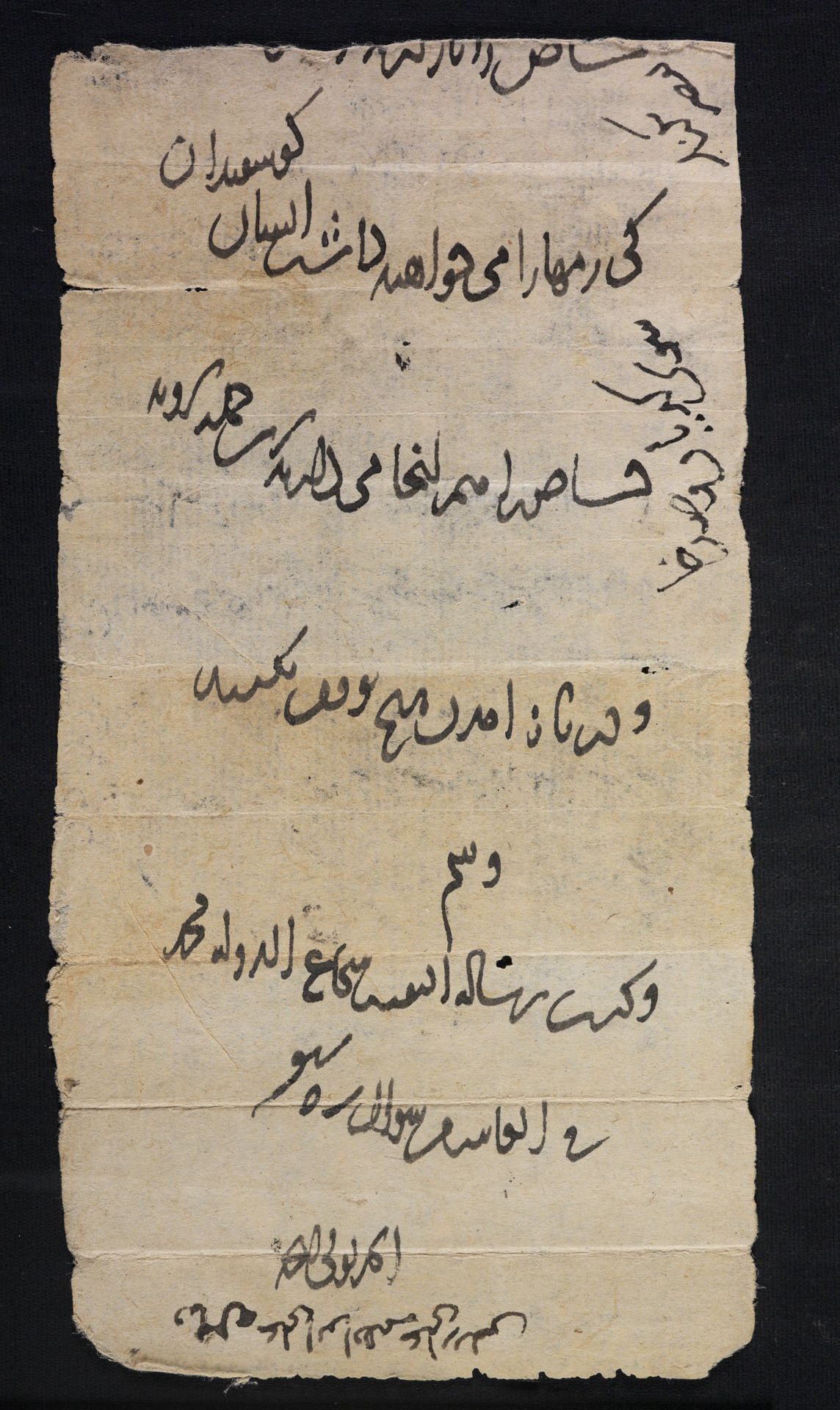
Folios
1. recto
Tags
Folio:
Transcription
Folio:
خاص را باز آرند (؟) [+/- 3] 1
کی رمها را می‌خواهند داشت ایشان گوسفندان 2
خاص را هم آنجا می‌دارند برین جمله بروند 3
و در باز آمدن هیج توقف نکنند 4
                        والسلم 5
و کتب برساله النقیب شجاع‌ الدوله محمد 6
فی العاشر من شوال سنه خمس سبعین 7
الحمد لولی الحمد 8
(حاشیه:) تقصیر نکنند 9
(حاشیه:) سوی کریان وصدخا 10
Palaeography

This document features a chancery script written in rotulus format. Lines curve upward and baselines are nested and stacked, with each succeeding word beginning above the previous. Words are stacked at line-ends. Interlinear spacing is noticeable. Abusive ligatures are frequent. Though there is little to no variation in ductus width and letterforms do not adhere to a consistent angle of incline, the remaining features — upward-curving lines, nested and stacked baselines, stacked words at line-ends, abusive ligatures, and noticeable interlinear spacing — conform to the graphic conventions of the Abbasid/Buyid chancery of Baghdad. The closing formulary is derived from the Seljuk chancery.


Further Reading


  • Shawe-Taylor, Edward. 2026. “Abbasid Continuities and Seljuk Innovations: Persian State Documents in the Bamiyan and Firuzkuh Papers.” In State Documents from the Medieval Islamicate World, edited by Nadia Vidro, Arezou Azad, and Marina Rustow. Edinburgh University Press, forthcoming.


Glossary


Abusive ligature — the joining of canonically non-connecting letters (e.g. alif) to a succeeding letter; a feature of both cursive and chancery scripts

Ductus — the movement of the pen caused by the gestures of the scribe when writing; particularly relevant when describing variation in stroke width between thick and thin strokes

Interlinear spacing — the space between lines of text

Nested baselines — baselines of individual words which are slanted, with succeeding words beginning above the end of the preceding word

Rotulus — a document in the form of a long vertical scroll

Stacked words — words written above one another toward the end of a line, a deliberate layout convention of the chancery style

National Library of Israel: Ms.Heb.8333.63, recto: Folio (recto)
Images courtesy of National Library of Israel