Khalili Collection: DOC 11 [AR 14]
  • Details
  • Tags
  • Transcriptions
  • Translations
  • Palaeography
  • Seals
Details
Download

Download IEDC Data

You are about to download data for the current text from the IEDC database.

To start the download, please click on your desired format below.

Note: it can take up to several minutes to download your data, so please wait whilst it processes

Download started

Content

Emancipation of a slave.

Dates

  • The Gregorian calendar: May-June 777 (0777-05-13 - 0777-06-11)
  • The Hijri calendar: Shaʿbān 160 (0160-08)

Details

DOC 11 [AR 14]
Khalili Collection
Gold (given following external peer review through journal/book publication)
Arabic (Arabic script)
Legal

Physical Description

parchment
fold lines
Written on light-colored parchment, the writing surface shows fold lines.
26.5
17.5

Publications

  • Khan, Geoffrey. 2007. Arabic documents from early Islamic Khurasan (Studies in the Khalili Collection Volume V). London: The Nour Foundation in association with Azimuth Editions. (Pages: 155-157)
    Catalogue Number: 30
    The IEDC translation and transcription have been taken from this publication

Related Shelfmarks

IEDC Data

56
02/12/2023
09/08/2026

Citations

Geoffrey Khan
Thomas Benfey
The transcription and translation have been taken from a previous publication (see Publications)
See 'How to Cite'
Images of this Text displayed on this web page are provided by Khalili Collection.
© Khalili Collection, All rights reserved.
If you wish to reproduce these images please contact Khalili Collection.

Contact

invisible_east@conted.ox.ac.uk (Please include the above permalink when contacting the editorial team about this Text)
Folios
1. recto
Tags
Folio:
Transcription
Folio:
بسم الله الرحمن الرحيم 1
هذا كتاب ما اعتق الحرث بن ملك 2
اعتق خادما له تسمى نوفاح وثلثة اولادتها منهم 3
العباس وحاتم وابنت تسما سندية اعتقهم 4
لوجه الله ليس لاحد عليــــــــــــــــــــــهم 5
سبيل الا سبيل الولا وللحرث 6
بن ملك وعقبه من بعده ولاهم 7
شهد بشر بن ابى الحرقا وزلاد جوزجان بن الجوزجان 8
وداود بن خويلد الازدى وعمرو بن عباس الحنظلى 9
ومحمد بن يزيد الازدى وعيسى بن سالم الحنظلى وهرون 10
بن عبد الملك الباهلى وزكريا بن عباس 11
وابرهيم بن عبد الله الباهلى ومسلم بن ابى 12
الحرقا وخلد مولى غالب 13
وكتــــــــــــــــــــــــــــــــــــــــــب فى 14
شعبان سنة ستين ومــــــــــــــــــــــاية 15
Translation
Folio:
1 In the name of God, the Merciful and Compassionate.
2 This is what al-Ḥārith b. Malik has emancipated.
3 He has emancipated a slave belonging to him called Nufāḥ and three of her children, these being
4 al-ʿAbbās, Ḥātim and a girl Sindiyya. He has emancipated them
5 for the sake of God. Nobody has
6 any right over them except the right of patronage. To al-Ḥārith
7 b. Malik and his descendants after him belongs their patronage.
8 It has been witnessed by Bishr b. Abū al-Ḥarqāʾ, Žulād Jūzjān b. al-Jūzjān,
9 Dāʾūd b. Khuwaylid al-Azdī, ʿAmr b. ʿAbbās al-Ḥanzṭalī,
10 Muḥammad b. Yazīd al-Azdī, ʿĪsā b. Sālim al-Ḥanzṭalī, Hārūn
11 b. ʿAbd al-Malik al-Bāhilī, Zakariyāʾ b. ʿAbbās,
12 Ibrāhīm b. ʿAbdallāh al-Bāhilī, Muslim b. Abū
13 al-Ḥarqāʾ and Khālid the client of Ghālib.
14 It has been written in
15 Shaʿbān of the year one hundred and sixty.
Palaeography

This document features a chancery script. The script is highly cursive. Letters are highly compressed and often written with a notable diagonal slant which contradicts the baseline, which is perfectly flat and straight.

Words are crowded across the line, occasionally alleviated using madd (letter lengthening).
e.g. kataba line 14


The curves of letters such as rāʾ, dāl, and nūn have been flattened.
e.g. Muḥammad bin Yazīd line 10


Some of these features, particularly flattened curves and diagonal strokes, are also found in contemporary Pahlavi documents. It is possible that bilingual Arabic-Pahlavi administrators imported elements of the ductus of Pahlavi script into their Arabic writing.


Glossary


Baseline — the line on which letters sit

Cursive — in Arabic palaeography, a technical term describing scripts characterized by obtuse angles, open curves, and diagonal strokes

Descender — the portion of a letter that extends below the baseline, as in rāʾ, zāyy, and lām

Ductus — the movement and sequence of strokes made by the scribe in forming letters

Madd — horizontal extension of letter strokes, used to fill space or as a decorative and calligraphic feature; also referred to as mashq in some traditions


Further Reading


Rustow, Marina. 2020. The Lost Archive: Traces of a Caliphate in a Cairo Synagogue. Princeton: Princeton University Press, 161-166.


Seals
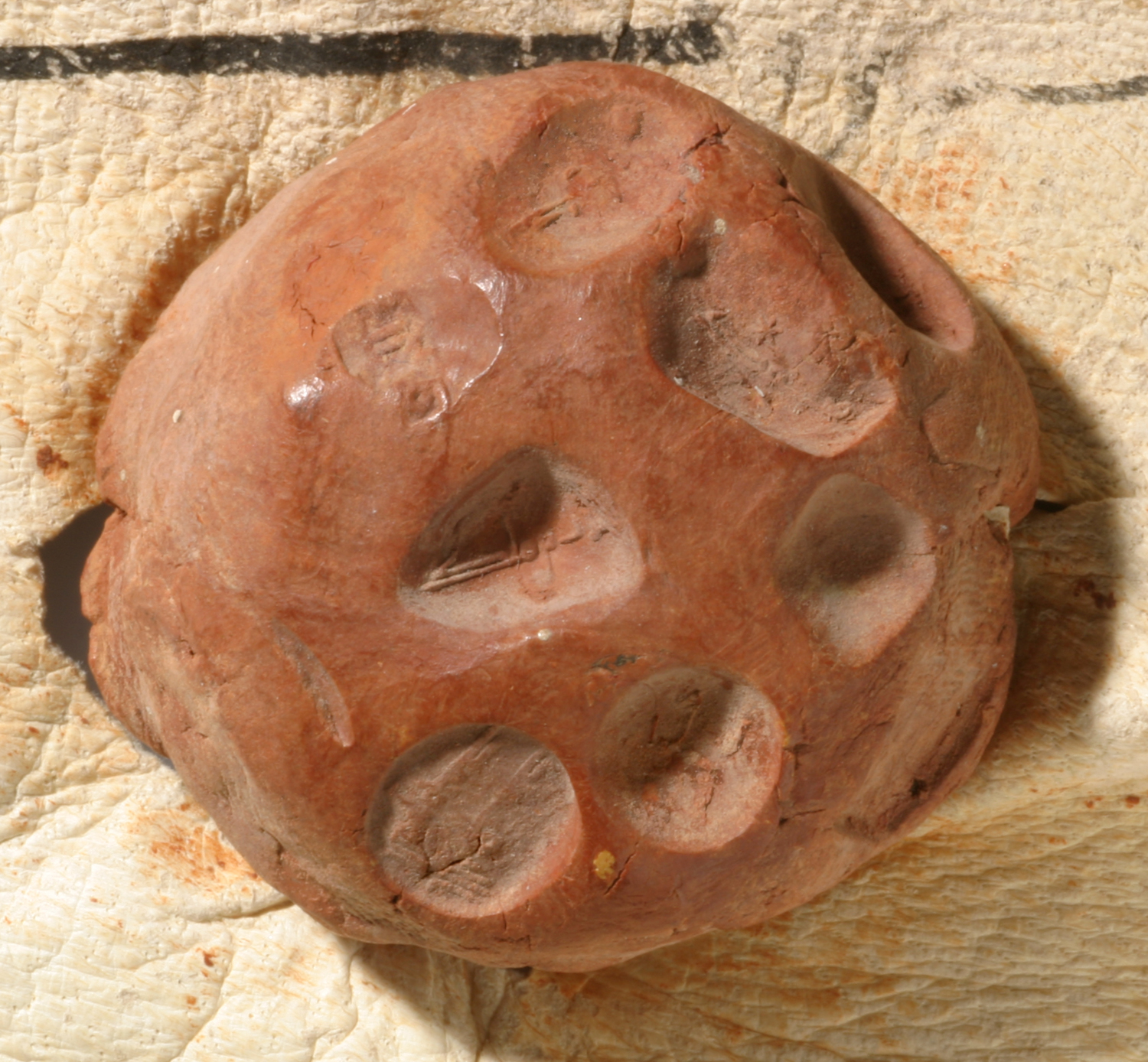
Seal 1
Photograph of this seal
Inscribed

Red coloured Bulla with a number of blank impressions, thumbnail marks, a seal depicting a quadruped walking left, and seals with the following inscriptions:
"al-Ḥārith b. Malik"
"May God be praised. May God be praised."
"Muḥammad [with a six-pointed star above]"

الحرث بن ملك

اللّه يحمد اللّه يحمد

محمد

  • red
  • animals
  • inscriptions
Seal 2
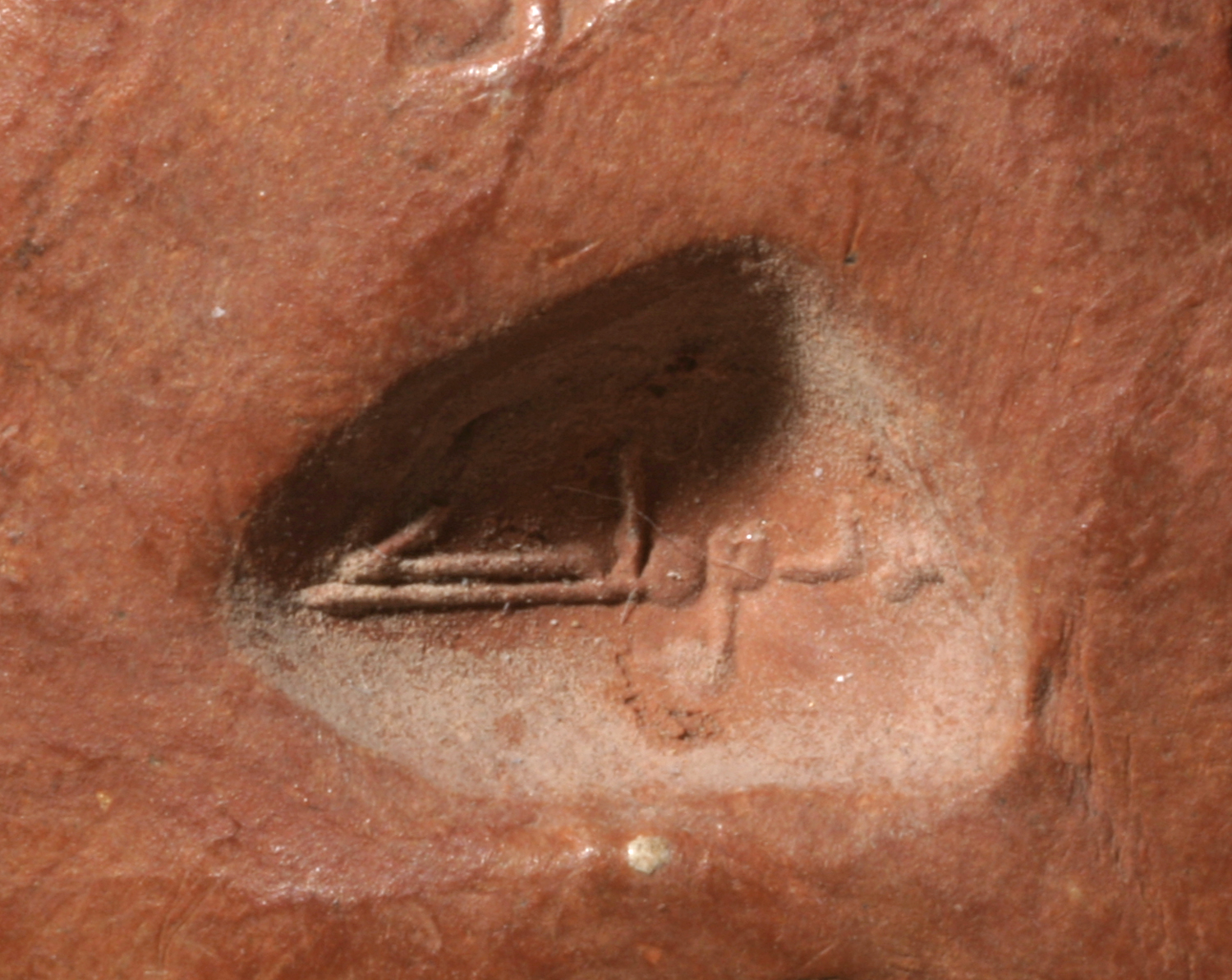
Photograph of this seal
close-up of signature

al-Hārith b. Malik

الحرث بن ملك

Khalili Collection: DOC 11 [AR 14]: Folio (recto)
Images courtesy of Khalili Collection