Khalili Collection: DOC 45 [AR 20]
  • Details
  • Tags
  • Transcriptions
  • Translations
  • Palaeography
  • Seals
Details
Download

Download IEDC Data

You are about to download data for the current text from the IEDC database.

To start the download, please click on your desired format below.

Note: it can take up to several minutes to download your data, so please wait whilst it processes

Download started

Content

Quittance relating to the dowry of Ḥamra, the daughter of Mīr b. Bēk.

Dates

  • The Gregorian calendar: September-August 766 (0766-08-16 - 0766-09-14)
  • The Hijri calendar: Rajab 149 (0149-07)

Details

DOC 45 [AR 20]
Khalili Collection
Gold (given following external peer review through journal/book publication)
Arabic (Arabic script)
Legal
Legal: Marriage

Physical Description

parchment
Written on light coloured parchment, the writing surface shows fold lines. There is a lacuna in the left corner.
16.5
12.0

Publications

  • Khan, Geoffrey. 2007. Arabic documents from early Islamic Khurasan (Studies in the Khalili Collection Volume V). London: The Nour Foundation in association with Azimuth Editions. (Pages: 147-9)
    Catalogue Number: 27
    The IEDC translation and transcription have been taken from this publication

Related Shelfmarks

IEDC Data

58
02/12/2023
09/08/2026

Citations

Geoffrey Khan
Thomas Benfey
The transcription and translation have been taken from a previous publication (see Publications)
See 'How to Cite'
Images of this Text displayed on this web page are provided by Khalili Collection.
© Khalili Collection, All rights reserved.
If you wish to reproduce these images please contact Khalili Collection.

Contact

invisible_east@conted.ox.ac.uk (Please include the above permalink when contacting the editorial team about this Text)
Folios
1. recto
Tags
Folio:
Transcription
Folio:
بسم الله الرحمن الرحيم 1
هذا كتاب براة من [موسى بن سلمن(؟)] وخيب 2
بن نشبود لمير الباميانى انا حاسبنك 3
بما كان لنا عليك من مهر ابنتك حمرة 4
خمس مية درهم وسوا ذلك ما دان لنا 5
عليك من دين قليل او كثير من قبالة 6
ينجب بن بيرونى ا و غيره فقد 7
قبضنا منك ذلك وبرئت 8
الينا منه كله فليس لنا قبلك 9
حق ولا طلبة شهد يحيى بن حبة 10
والعذافر ب ن صفوان وعبد الله مولى حر 11
ث ومحمد بن سعيد وعبد الله 12
بن سليمن وخاقان بن قدودى وخلد 13
بن شيبان وكتب فى رجب 14
سنة تسع واربعين ومية 15
Translation
Folio:
1 In the name of God, the Merciful and Compassionate.
2 This is a document of quittance from [Mūsā b. Salmān] and Khīb
3 b. Nashbūd to Mīr, the man from Bāmiyān. We have settled our account with you
4 concerning what you owed us with regard to the dowry of your daughter Ḥamra,
5 five hundred dirhams, and in addition to that whatever debt you owed us,
6 little or much, with regard to the contract
7 of Yanjub b. Bīrūnī [?] or anybody else. We have
8 received that from you and you have been released
9 from (the obligation to pay) it to us and we have no
10 right or demand against you. It was witnessed by Yaḥyā b. Ḥabba,
11 al-ʿUdhāfir b. Sṭafwān, ʿAbdallāh the client of Ḥārith,
12 Muḥammad b. Saʿīd, ʿAbd Allāh
13 b. Sulaymān, Khāqān b. Frodā [??] and Khālid
14 b. Shaybān. It was written in Rajab
15 of the year one hundred and forty nine.
Palaeography

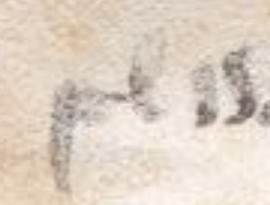
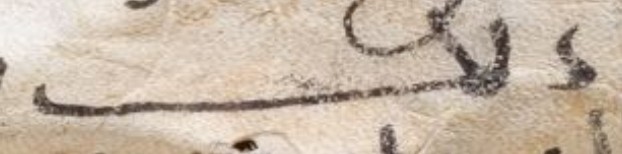
This document features a chancery script. The script is highly cursive. Letters are highly compressed and often written with a notable diagonal slant which contradicts the baseline, which is perfectly flat and straight.

Words are crowded across the line, occasionally alleviated using madd (letter lengthening).
e.g. dhalika line 8


The curves of letters such as rāʾ, dāl, and wāw have been flattened.
e.g. dirham line 5


Some of these features, particularly flattened curves and diagonal strokes, are also found in contemporary Pahlavi documents. It is possible that bilingual Arabic-Pahlavi administrators imported elements of the ductus of Pahlavi script into their Arabic writing.


Glossary


Baseline — the line on which letters sit

Cursive — in Arabic palaeography, a technical term describing scripts characterized by obtuse angles, open curves, and diagonal strokes

Descender — the portion of a letter that extends below the baseline, as in rāʾ, zāyy, and lām

Ductus — the movement and sequence of strokes made by the scribe in forming letters

Madd — horizontal extension of letter strokes, used to fill space or as a decorative and calligraphic feature; also referred to as mashq in some traditions


Further Reading


Rustow, Marina. 2020. The Lost Archive: Traces of a Caliphate in a Cairo Synagogue. Princeton: Princeton University Press, 161-166.


Seals
Seal 1
Photograph of this seal
Unknown

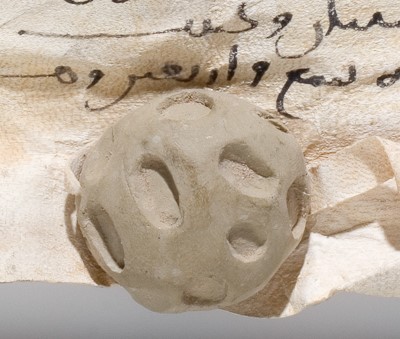
The bulla contains eight impressions, two of which are made with thumbnails and the remaining six with a seal. No seal inscriptions are visible.

  • brown
Khalili Collection: DOC 45 [AR 20]: Folio (recto)
Images courtesy of Khalili Collection