Afghanistan National Archives: Firuzkuh 88
  • Details
  • Transcriptions
  • Translations
  • Palaeography
Details
Download

Download IEDC Data

You are about to download data for the current text from the IEDC database.

To start the download, please click on your desired format below.

Note: it can take up to several minutes to download your data, so please wait whilst it processes

Download started

Content

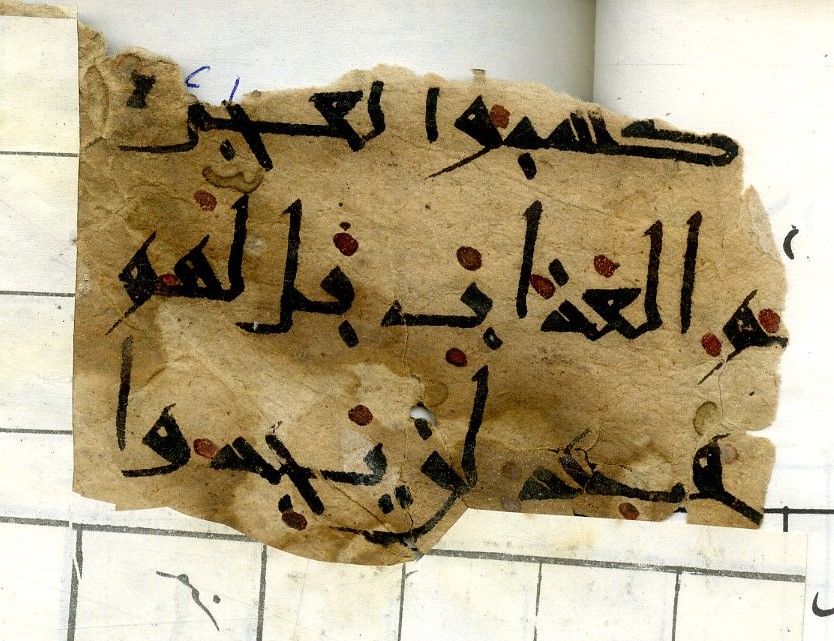
A fragment from a Qur'an containing a verse from Surat al-Kahf (Q.18:58).

Dates

(Dates unknown)

Details

Firuzkuh 88
Silver (given following internal peer review)
Arabic (Arabic script)

Physical Description

paper
Incomplete, black red and green ink; recto sheet Firuzkuh 89

People

Publications

  • Khwaja Muhammad and Nabi Saqee, Barg-hāy az yak faṣl, yā asnād-i tārīkhī-yi Ghur (Kabul: Saʿīd 1388/2009) (Pages: 18)
    image only
  • https://invisibleeast.web.ox.ac.uk/article/document-month-725-fragments-once-complete-qurans

IEDC Data

1233
14/04/2025
24/05/2026

Citations

Nabi Saqee
Arezou Azad, Mateen Arghandehpour
The transcription and translation are the original work of the IEDC Team (as yet unpublished in peer-review print)
See 'How to Cite'
Images of this Text displayed on this web page are provided by Nabi Saqee.
© Nabi Saqee, All rights reserved.
If you wish to reproduce these images please contact Nabi Saqee.

Contact

invisible_east@conted.ox.ac.uk (Please include the above permalink when contacting the editorial team about this Text)
Folios
1. recto
Transcription
Folio:
[يؤاخذهم بما ] کسبوا العجل 1
[لهـ]م العذاب بل لهم 2
[مو]عد لن یجدوا [من دونه موئلا] 3
Translation
Folio:
1 [But your Lord is the All-Forgiving, the One full of mercy. If He were to take them to task for what] they have earned, He would hasten
2 the torment for them.
3 but they will have a tryst [on this side] of which they will find [no escape].
Palaeography

This fragment is written in a Qur’anic script known as the ‘New Style’. The script is characterised by triangular and trapezoidal heads of letters and diagonal descending strokes in bowls and tails. Descending strokes are straight and diagonal, giving the script an orthogonal and rigid overall aspect. Vocalisation is marked using the old dot system: a dot above the letter represents a fatḥa, one below represents a kasra, and a dot on the line represents a ḍamma. Additional diacritical marks, including sukūn and shadda, were added in a green iron-based ink, now oxidised.


Further Reading


Glossary


Bowl — the rounded closed or semi-closed curve of a letter which descends below the baseline, as in wāw, qāf, nūn, and sīn

Ḍamma — a vocalisation mark indicating a short /u/ vowel

Descender — the portion of a letter that extends below the baseline, as in rāʾ, zāyy, and lām

Diacritical marks — signs added to letters to indicate vocalisation or other phonetic features, including fatḥa, kasra, ḍamma, sukūn, and shadda

Fatḥa — a vocalisation mark indicating a short /a/ vowel

Kasra — a vocalisation mark indicating a short /i/ vowel

New Style — an eastern Qur’anic script characterised by triangular and trapezoidal letter heads and diagonal descending strokes in bowls and tails

Orthogonal — composed of right angles; used to describe scripts in which strokes meet at ninety degrees, producing a rigid, angular aspect

Shadda — a diacritical mark indicating doubling of a consonant; also called tashdīd

Sukūn — a diacritical mark indicating the absence of a vowel following a consonant

Afghanistan National Archives: Firuzkuh 88: Folio (recto)
Images courtesy of Nabi Saqee