Afghanistan National Archives: Firuzkuh 20
  • Details
  • Tags
  • Transcriptions
  • Translations
Details
Download

Download IEDC Data

You are about to download data for the current text from the IEDC database.

To start the download, please click on your desired format below.

Note: it can take up to several minutes to download your data, so please wait whilst it processes

Download started

Content

Two legal queries (istiftā) about inheritance rights and the validity of indirect testimony. The first query concerns the confirmation of a woman's death. The religious authorities are asked whether the husband’s acknowledgement (iqrār) and the witnesses’ testimony, despite lacking direct observation, are sufficient to establish the wife’s death and permit her brother to release her inheritance. The response rules that the witnesses’ testimony is invalid. The second query concerns the validity of a testimony given by a claimant in a specific legal case. The response, written by Muḥammad b. Maḥmūd, rules that the claimant’s testimony is invalid.

Dates

(Dates unknown)

Details

Firuzkuh 20
Silver (given following internal peer review)
New Persian (Arabic script)
Legal
Legal: Testimony

Physical Description

paper
Complete, black ink; in the bottom right corner is a note written by Mirza Khwaja Muhammad in ball point pen
6
horizontal

Publications

Related Shelfmarks

IEDC Data

1302
31/10/2025
12/01/2026

Citations

Ofir Haim
The transcription has been revised from a previous publication (see Publications).
See 'How to Cite'
Images of this Text displayed on this web page are provided by Nabi Saqee.
© Nabi Saqee, All rights reserved.
If you wish to reproduce these images please contact Nabi Saqee.

Contact

invisible_east@conted.ox.ac.uk (Please include the above permalink when contacting the editorial team about this Text)
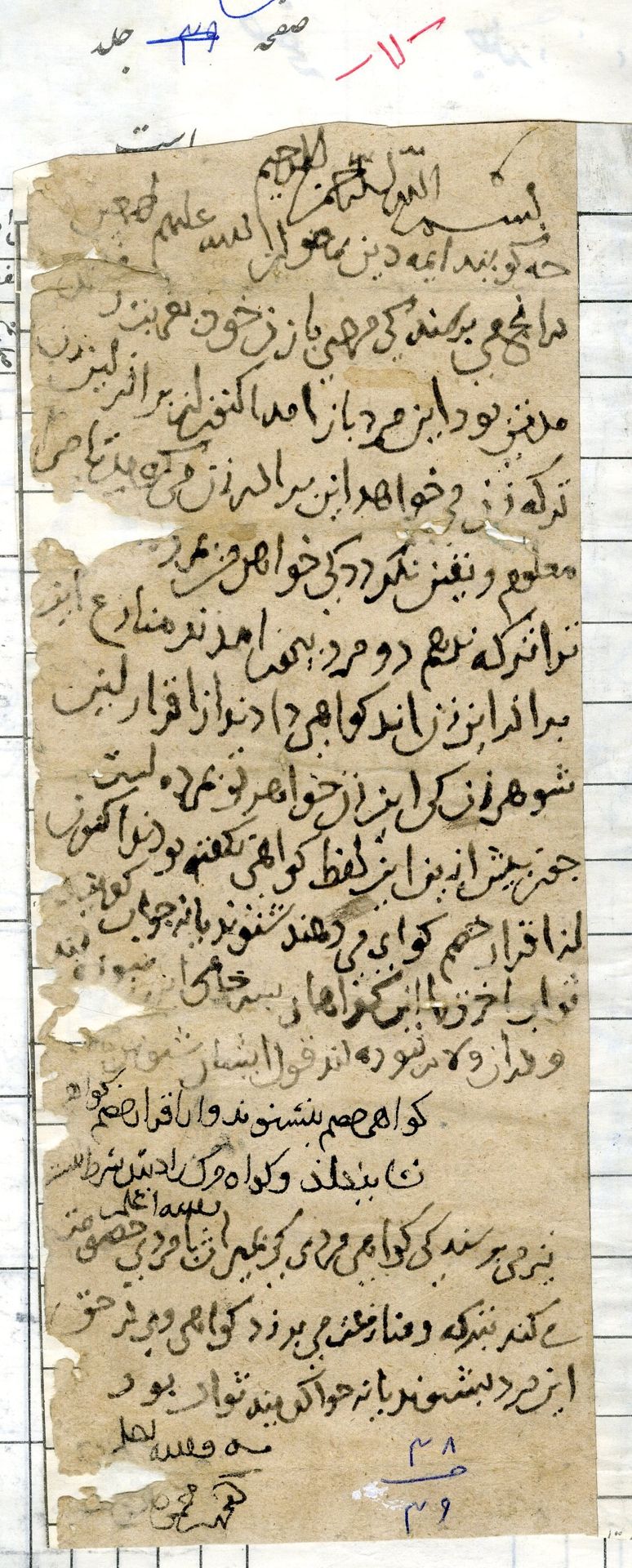
Folios
1. recto
Tags
Folio:
Transcription
Folio:
بسم الله الرحمن الرحیم 1
چه گویند اییمه دین رضوان‌ الله علیهم اجمعین 2
 در آنچ می‌ پرسند کی مردی با زن خود بغربت ر[فتنـ]ـد 3
 مدتی بود این مرد باز آمد اکنون از برادر این زن 4
 ترکه زن می‌خواهد این برادر زن می گوید تا مرا 5
 معلوم و یقین نگردد کی خواهر من بمرده [است] 6
 ترا ترکه ندهم دو مرد بیرون آمدند منازع این 7
 برادر این زن اند گواهی دادند از اقرار این 8
 شوهر زن کی این زن خواهر تو بمرده است 9
 چون پیش ازین این لفظ گواهی نگفته بودند اکنون  10
 از اقرار خصم گواهی می‌ دهند شنوند یا نه جواب گویند 11
 ثواب اخرت را این گواهان بسر خاک این [زن] نبوده اند 12
 و دران ولایت نبوده اند قول ایشان شنوند یا نه 13
 گواهی خصم بنشنوند و از اقرار خصم گواهی  14
 نشاید داد و گواه مرگ را دیدن شرط است 15
 والله اعلم 16
نیز می‌ پرسند کی گواهی مردی کی بمیراث با مردی خصومت 17
 می‌ کند بترکه و منازعت می‌ برزد گواهی وی در حق 18
 این مرد بشنوند یا نه جوا[ب] گویند ثواب بود 19
نه والله اعلم 20
کتبه محمد بن محمود [+ 2] 21
Translation
Folio:
1 In the name of God, the Merciful, the Compassionate. 
2 What is the [judgement] of the imams of the faith, may God be pleased with them all, 
3 regarding their [first] query: A man moved far away with his wife. 
4 After a while, this man returned. Now he is asking her brother for  
5 his wife’s inheritance. This brother-in-law says: “Until I have 
6 clarity and certainty that my sister is dead 
7 I shan’t give you her inheritance.” Two men appeared and  
8 gave testimony in opposition to the brother-in-law based on the  
9 husband’s claim, [stating]: “This woman, your sister, is dead.” 
10 Because they hadn’t made a statement earlier, they are now 
11 testifying based on the adverse party’s claim. Is this testimony admissible or not? What is their judgement, 
12 that they may receive recompense in the afterlife? These testifiers have not been at the [woman’s] grave, 
13 and they have never been to that province [where she died]. Shall their testimony be heard or not? 
14 They shall not hear their testimony; testimony based on an adverse party’s claim  
15 is not admissible. Eye witness testimony is stipulated [as required for the confirmation] of [someone’s] death. 
16 God knows best. 
17-19 Their [second] query is this: Is the testimony given by a man against another with whom is also involved in an inheritance-related dispute admissible? What is their judgement, that they may receive recompense in the afterlife? 
20 No. God knows best. 
21 It was written by Muḥammad b. Maḥmūd [+2]. 
Afghanistan National Archives: Firuzkuh 20: Folio (recto)
Images courtesy of Nabi Saqee