National Library of Israel: Ms.Heb.8333.27
  • Details
  • Tags
  • Transcriptions
  • Palaeography
Details
Download

Download IEDC Data

You are about to download data for the current text from the IEDC database.

To start the download, please click on your desired format below.

Note: it can take up to several minutes to download your data, so please wait whilst it processes

Download started

Content

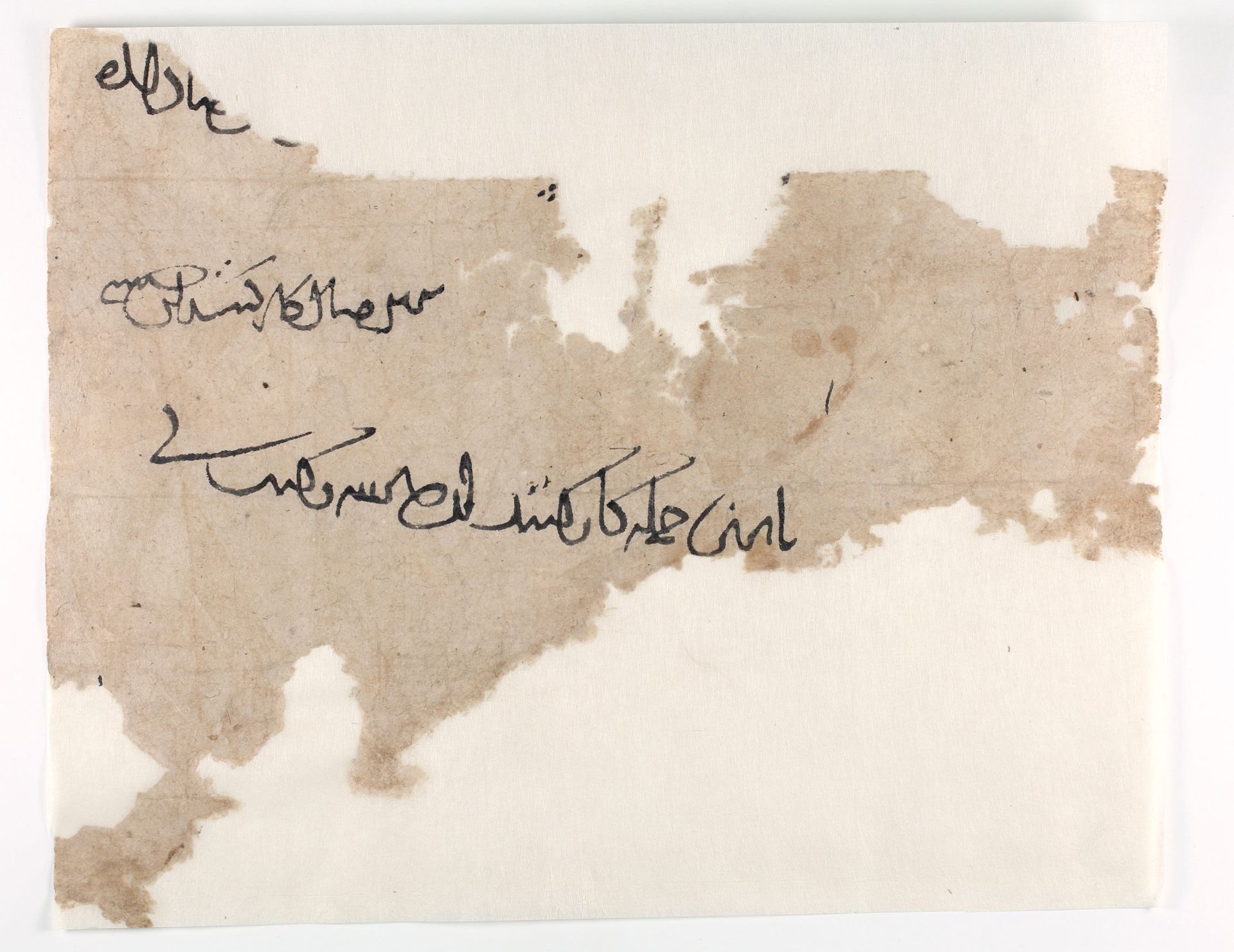
Fragment from the bottom of a chancery decree. The document may have been issued in the Ghaznavid period, as it pertains to the first 29 documents purchased by the NLI in 2013. Most of these documents are dated to the first half of the eleventh century.

Dates

  • The Gregorian calendar: Undated

Details

Ms.Heb.8333.27
Silver (given following internal peer review)
New Persian (Arabic script)

Physical Description

paper
Incomplete (small fragment), wide line spacing, black ink; verso is blank
3
horizontal
ca. 3 horizontal fold lines

People

Publications

Related Shelfmarks

IEDC Data

166
02/09/2024
24/05/2026

Citations

Ofir Haim
Nabi Saqee
The transcription and translation are the original work of the IEDC Team (as yet unpublished in peer-review print)
See 'How to Cite'
Images of this Text displayed on this web page are provided by National Library of Israel.
© National Library of Israel, All rights reserved.
If you wish to reproduce these images please contact National Library of Israel.

Contact

invisible_east@conted.ox.ac.uk (Please include the above permalink when contacting the editorial team about this Text)
Folios
1. recto
Tags
Folio:
Transcription
Folio:
[+/- 7] رضا (؟) داده 1
                   برین مثال کار کنند ان شاء الله 2
تا برین جمله کار کنند ان شاء الله و کتب فی 3
Palaeography

This document features a chancery script. The script is curvilinear and proportioned with a variable ductus and pervasive hairlines.

Abusive ligatures are frequent. Letter shapes are regular and consistent. Baselines are nested and stacked, with words written on a diagonally slanted baseline, each succeeding word beginning above the previous. Words are stacked toward the ends of lines. Interlinear spacing is wide. Lines slope upward. A kollesis (glue seam) runs through line 3, suggesting that the document may have originally been in a long rotulus format.

These features — curvilinear and proportioned script, variable ductus, pervasive hairlines, abusive ligatures, nested and stacked baselines, stacked words at line-ends, wide interlinear spacing, upward-sloping lines, and large multi-sheet format — conform to the graphic conventions of the Abbasid/Buyid chancery of Baghdad.


Further Reading


  • Rustow, Marina. 2020. The Lost Archive: Traces of a Caliphate in a Cairo Synagogue. Princeton: Princeton University Press.
  • Shawe-Taylor, Edward. 2026. “Abbasid Continuities and Seljuk Innovations: Persian State Documents in the Bamiyan and Firuzkuh Papers.” In State Documents from the Medieval Islamicate World, edited by Nadia Vidro, Arezou Azad, and Marina Rustow. Edinburgh University Press, forthcoming.


Glossary


Abusive ligature — the joining of canonically non-connecting letters (e.g. alif) to a succeeding letter; a feature of both cursive and chancery scripts

Curvilinear — a script characterised by long, rounded, flowing strokes, most evident in the loops of letters such as fā or ʿayn, and in the bowls of letters such as yāʾ or nūn; distinct from cursive

Ductus — the movement of the pen caused by the gestures of the scribe when writing; particularly relevant when describing variation in stroke width between thick and thin strokes

Hairline — a very fine, thin stroke, typically connecting letters

Interlinear spacing — the space between lines of text

Kollesis — a glue seam where two sheets of paper or papyrus have been joined

Nested baselines — baselines of individual words which are slanted, with succeeding words beginning above the end of the preceding word

Proportioned script — a script in which letterforms are executed according to consistent geometric ratios, typically based on the height of the alif and the diameter of a circle; associated with formal calligraphic training

Rotulus — a document in the form of a long vertical scroll

Stacked words — words written above one another toward the end of a line, a deliberate layout convention of the chancery style

National Library of Israel: Ms.Heb.8333.27: Folio (recto)
Images courtesy of National Library of Israel