Khalili Collection: DOC 22 [AR 7]
  • Details
  • Tags
  • Transcriptions
  • Translations
  • Palaeography
  • Seals
Details
Download

Download IEDC Data

You are about to download data for the current text from the IEDC database.

To start the download, please click on your desired format below.

Note: it can take up to several minutes to download your data, so please wait whilst it processes

Download started

Content

Quittance relating to the dowry of Ḥamra, the daughter of Mīr b. Bēk.

Dates

  • The Gregorian calendar: January-February 765 (0765-01-28 - 0765-02-25)
  • The Hijri calendar: Dhū l-Ḥijja 147 (0147-12)

Details

DOC 22 [AR 7]
Khalili Collection
Gold (given following external peer review through journal/book publication)
Arabic (Arabic script)
Legal
Legal: Marriage

Physical Description

parchment
staining
Written on light parchment with browning in places.
16.0
9.5

Publications

  • Khan, Geoffrey. 2007. Arabic documents from early Islamic Khurasan (Studies in the Khalili Collection Volume V). London: The Nour Foundation in association with Azimuth Editions. (Pages: 144-146)
    Catalogue Number: 26
    The IEDC translation and transcription have been taken from this publication

Related Shelfmarks

IEDC Data

34
02/12/2023
09/08/2026

Citations

Geoffrey Khan
Thomas Benfey
The transcription and translation have been taken from a previous publication (see Publications)
See 'How to Cite'
Images of this Text displayed on this web page are provided by Khalili Collection.
© Khalili Collection, All rights reserved.
If you wish to reproduce these images please contact Khalili Collection.

Contact

invisible_east@conted.ox.ac.uk (Please include the above permalink when contacting the editorial team about this Text)

Folios
1. recto
Tags
Folio:
Transcription
Folio:
بسم الله الرحمن الرحيم 1
هذا كتاب من موسى 2
بن سلمن براة لمير بن بيك 3
انى قبضت منك سبعين درهما 4
المية على عشرين مما كان لخيب 5
بن نشبود علي من مهر [حـ]ـمرة ابنة 6
مير بن بيك وقد قبض ذلك موسى 7
بن سلمن منى سبعين درهما المية 8
على عشرين وبرئت اليه منه 9
شهد قتيبة بن بلور والهيلب 10
( بن يونس وعبد الله بن سلمن وخاقان ) 11
فردى وسام بن الفرخ وعبد الله 12
(بن مولى غالب والاوحد بن حيمر وجهم ) 13
قيس وجملة مولى زرعة وعيسى 14
بن سالم وكتب فى ذى الحجة 15
سنة سبع واربعين ومية 16
Translation
Folio:
1 In the name of God, the Merciful and Compassionate.
2 This is a document from Mūsā
3 b. Salmān, a quittance for Mīr b. Bēk.
4 I have received from you seventy dirhams,
5 a hundred at a rate of twenty, what Khīb
6 b. Nashbūd is owed by me with regard to the dowry of Ḥamra, the daughter
7 of Mīr b. Bēk. Mūsā b. Salmān has received that
8 from me, seventy dirhams, a hundred
9 at a rate of twenty, and I have become released from (obligation to pay) it to him.
10 It was witnessed by Qutayba b. Billawr, Haylab
11 b. Yūnus, ʿAbdallāh b. Salmān, Khāqān b.
12 Frōdā, Sām b. al-Farrukh, ʿAbdallāh
13 the client of Ghālib al-Awḥad b. Ḥaymir, Jahm b.
14 Qays, Jumla the client of Zurʿa and ʿĪsā
15 b. Sālim. It was written in Dhū al-Ḥijja
16 of the year one hundred and forty-seven.
Palaeography

This document features a chancery script. The script is highly cursive. Letters are highly compressed and often written with a notable diagonal slant which contradicts the baseline, which is perfectly flat and straight.

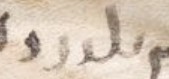
Words are crowded across the line, occasionally alleviated using madd (letter lengthening).
e.g. kitāb line 2


The curves of letters such as rāʾ, nūn, and lām have been flattened.
e.g. Billawr line 10


Some of these features, particularly flattened curves and diagonal strokes, are also found in contemporary Pahlavi documents. It is possible that bilingual Arabic-Pahlavi administrators imported elements of the ductus of Pahlavi script into their Arabic writing.


Glossary


Baseline — the line on which letters sit

Cursive — in Arabic palaeography, a technical term describing scripts characterized by obtuse angles, open curves, and diagonal strokes

Descender — the portion of a letter that extends below the baseline, as in rāʾ, zāyy, and lām

Ductus — the movement and sequence of strokes made by the scribe in forming letters

Madd — horizontal extension of letter strokes, used to fill space or as a decorative and calligraphic feature; also referred to as mashq in some traditions


Further Reading


Rustow, Marina. 2020. The Lost Archive: Traces of a Caliphate in a Cairo Synagogue. Princeton: Princeton University Press, 161-166.


Seals
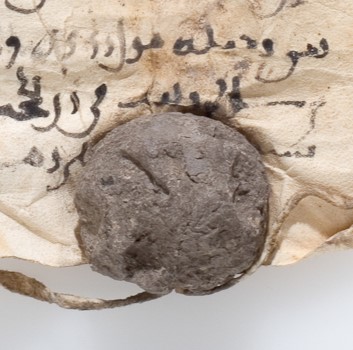
Seal 1
Photograph of this seal
Unknown

The seal contains seven impressions all of which are eroded.

Khalili Collection: DOC 22 [AR 7]: Folio (recto)
Images courtesy of Khalili Collection