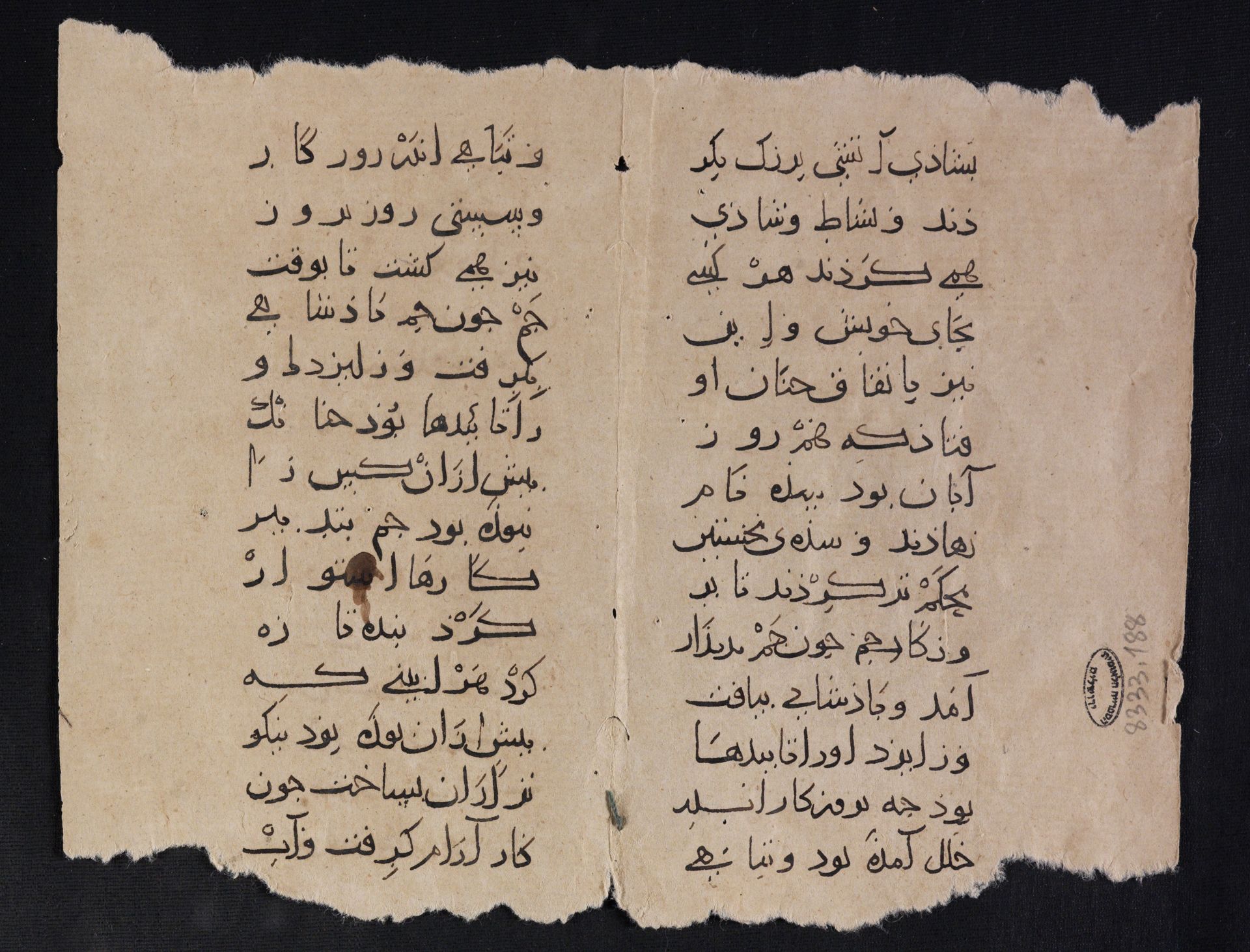
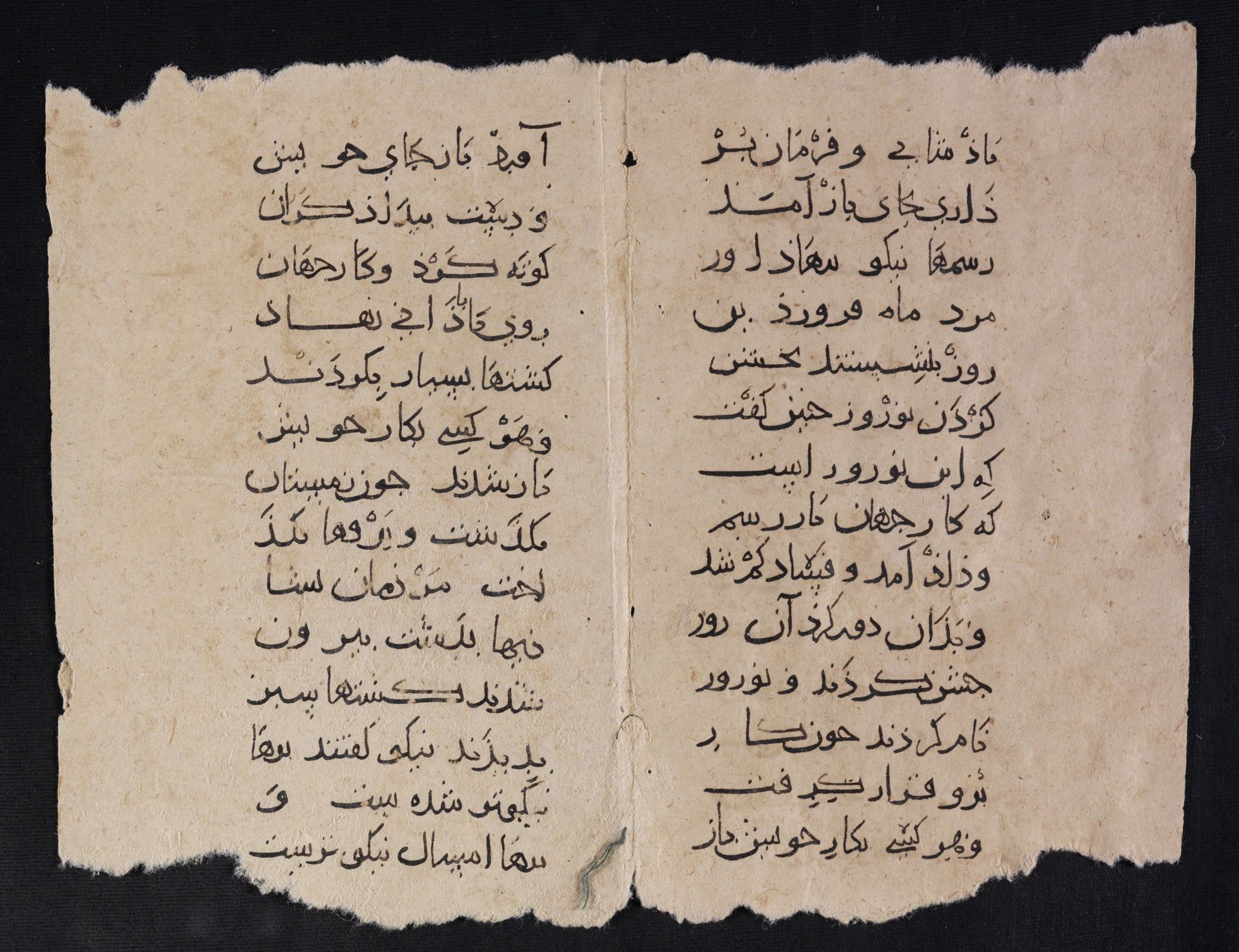
This fragment is written in the angular script of a bookhand typical of the tenth century. The script is transitional between the angular scripts that characterised ninth- and tenth-century bookhands and the curvilinear scripts which began to appear in the tenth century.
The baseline is very straight. Spaces are often left between letters — including those within the same word — in order to justify the page, a practice ultimately deriving from Kufic calligraphy.
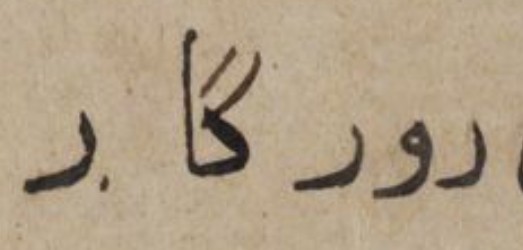
e.g. rūzigār line 15:

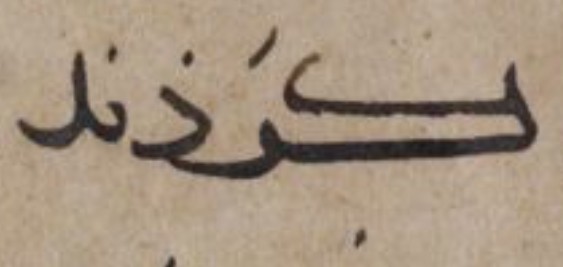
The letter kāf is mostly executed in its more archaic form, made up of a single stroke and featuring a long horizontal extension of two parallel lines.
e.g. gardand line 3:

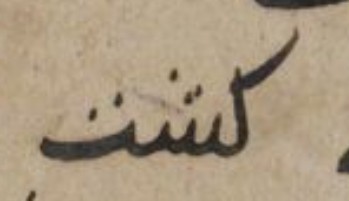
On line 11 of the left-hand side of the recto, however, a kāf more typical of curvilinear scripts also appears, made up of an inward-curving ligature with a separate stroke attached at the head.
e.g. kusht line 17:

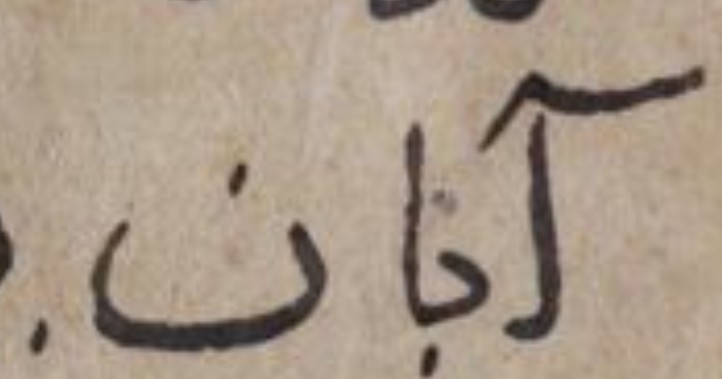
The bowls of letters such as nūn and sīn are often written perfectly rounded to form a semicircle, recalling the newly emerging curvilinear style.
e.g. ʾābān line 7:

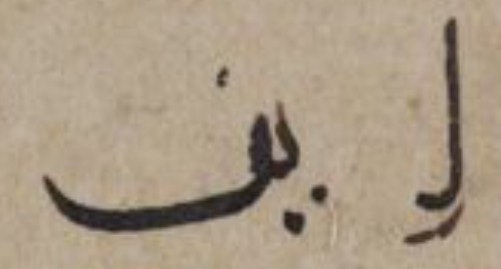
Elsewhere, however, they are flattened, and left open, in the manner of more archaic angular scripts.
e.g. ʾīn line 4:

Glossary
Angular — a script style in which letterforms are constructed using straight strokes meeting at sharp angles, without curves; characteristic of early Arabic bookhands and ‘New Style’ Qur’anic scripts
Baseline — the line on which letters sit
Bookhand — a script style associated with the copying of manuscripts, typically more formal and regular than documentary hands
Bowl — the rounded closed or semi-closed curve of a letter which descends below the baseline, as in wāw, qāf, nūn, and sīn
Curvilinear — a script characterised by long, rounded, flowing strokes, most evident in the loops of letters such as fā or ʿayn, and in the bowls of letters such as yāʾ or nūn; distinct from cursive
Justification — the process of aligning text so that both the left and right edges are flush with the margins, creating a clean, rectangular block of text
Kufic — an early angular Arabic script used in Qur’anic manuscripts from the eighth to tenth centuries, characterised by angular letterforms and horizontal page orientation
Ligature — the joining of two or more letters into a single connected stroke
Transitional script — a script which exhibits features of two distinct scribal traditions, reflecting a period of change between one dominant style and another
Further Reading
This fragment is written in the angular script of a bookhand typical of the tenth century. The script is transitional between the angular scripts that characterised ninth- and tenth-century bookhands and the curvilinear scripts which began to appear in the tenth century. The baseline is very straight. Spaces are often left between letters — including those within the same word — in order to justify the page, a practice ultimately deriving from Kufic calligraphy. The letter kāf is mostly executed in its more archaic form, made up of a single stroke and featuring a long horizontal extension of two parallel lines. On line 11 of the left-hand side of the recto, however, a kāf more typical of curvilinear scripts also appears, made up of an inward-curving ligature with a separate stroke attached at the head. The bowls of letters such as nūn and sīn are perfectly rounded to form a semicircle, recalling the newly emerging curvilinear style.
Further Reading
Glossary
Angular — a script style in which letterforms are constructed using straight strokes meeting at sharp angles, without curves; characteristic of early Arabic bookhands and ‘New Style’ Qur’anic scripts
Baseline — the line on which letters sit
Bookhand — a script style associated with the copying of manuscripts, typically more formal and regular than documentary hands
Bowl — the rounded closed or semi-closed curve of a letter which descends below the baseline, as in wāw, qāf, nūn, and sīn
Curvilinear — a script characterised by long, rounded, flowing strokes, most evident in the loops of letters such as fā or ʿayn, and in the bowls of letters such as yāʾ or nūn; distinct from cursive
Justification — the process of aligning text so that both the left and right edges are flush with the margins, creating a clean, rectangular block of text
Kufic — an early angular Arabic script used in Qur’anic manuscripts from the eighth to tenth centuries, characterised by angular letterforms and horizontal page orientation
Ligature — the joining of two or more letters into a single connected stroke
Transitional script — a script which exhibits features of two distinct scribal traditions, reflecting a period of change between one dominant style and another